TLDR
- Advanced Process Control (APC) systems deliver measurable ROI within 12-24 months through automated optimization
- Top vendors range from global software providers to specialized systems integrators and AI platforms
- Market growth to $7.4B by 2035 means expanding vendor options and competitive pricing
- Selection criteria include technology maturity, integration capabilities, industry expertise, and total cost of ownership
Overview of Process Control in Industrial Manufacturing
Manufacturing plants lose thousands of dollars daily to process variability, energy waste, and throughput bottlenecks. Advanced process control (APC) systems solve these problems by using predictive algorithms to optimize operations before disturbances impact quality or output.
The financial returns are substantial. Validated benchmarks show implementations typically deliver payback in 3 to 9 months, with best-in-class projects achieving ROI in under 6 months.
Key performance improvements include:
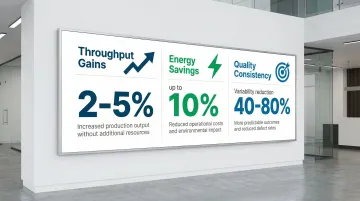
- Throughput gains: 2-5% increases in production capacity
- Energy savings: Up to 10% reduction in consumption
- Quality consistency: 40-80% reduction in process variability
The companies listed below represent a mix of established control system vendors, emerging AI-driven platforms, and specialized integrators who implement and support these technologies across diverse industrial sectors.
Top 10 Process Control Companies for Industrial Optimization
Choosing the right process control partner directly impacts your facility's efficiency, safety, and profitability. The following companies represent leaders in industrial optimization, each offering distinct strengths across different manufacturing environments.
Selection criteria include technology innovation, market presence, integration capabilities, and proven ROI in real-world implementations.
AspenTech (Aspen DMC3)
AspenTech pioneered advanced process control over 40 years ago. The company specializes in model predictive control (MPC) and optimization software for process industries, with dominant presence in oil & gas, chemicals, and refining.
Key advantages: Aspen DMC3 combines linear and nonlinear variables in a single model using AI, with "Smart Tune" technology and continuous background model identification that maintains performance without disruptive step-testing. The platform's adaptive capabilities automatically adjust to changing plant conditions, addressing the common issue of model degradation over time.
| Key Strengths | Deep process modeling expertise, advanced optimization algorithms, proven ROI in energy-intensive industries |
|---|---|
| Best For | Large-scale refineries, chemical plants, and facilities requiring sophisticated multi-variable control |
| Notable Features | Aspen DMC3 platform with AI-driven adaptation, integrated planning optimization, extensive historical performance database |
Honeywell Process Solutions (Profit Controller)
Honeywell leads the industrial automation market with comprehensive process control solutions. Their platform combines distributed control systems (DCS) with advanced process control through seamless Experion integration.
What sets it apart: A refinery steam optimization project achieved payback in less than 6 months and reduced CO2 emissions by 6,200 tons per year. The Profit Controller uses Robust Multivariable Predictive Control Technology (RMPCT) to handle complex process interactions, with research showing clients achieving 10-15% efficiency gains.
| Key Strengths | End-to-end automation integration, reliable performance in complex processes, strong cybersecurity features |
|---|---|
| Best For | Oil & gas, petrochemicals, power generation, and facilities requiring unified control architecture |
| Notable Features | Profit Controller APC, Experion PKS integration, Uniformance historian connectivity |
Emerson Electric (DeltaV and ControlWave)
Emerson provides scalable automation solutions through their DeltaV platform. The system serves industries from discrete manufacturing to continuous process operations with embedded MPC capabilities.
Notable benefits: In a verified refinery case study, embedded APC tools reduced the standard deviation of key process variables by 48% to 81%, allowing operators to push processes closer to constraints and generating an estimated $280,000 profit per day. The embedded architecture eliminates external server hardware and complex data interfaces.
| Key Strengths | Scalable solutions for diverse plant sizes, embedded MPC in DCS controller, proven reliability |
|---|---|
| Best For | Pharmaceutical, food & beverage, water treatment, and mid-sized manufacturing operations |
| Notable Features | DeltaV Predict and PredictPro embedded MPC, predictive maintenance tools, cloud connectivity options |
Siemens (Simatic PCS 7)
Siemens offers highly scalable process control systems adaptable to multiple industrial environments. The platform supports discrete to hybrid manufacturing operations with comprehensive digital twin capabilities.
Key advantages: SIMATIC PCS 7 integrates APC functionalities directly into control system libraries through the Advanced Process Library. The platform emphasizes SIMIT simulation for virtual commissioning, allowing engineers to test APC strategies in a software-in-the-loop environment before deployment, reducing commissioning risk.
| Key Strengths | Highly scalable architecture, digital twin integration via SIMIT, broad industry applicability |
|---|---|
| Best For | Large enterprises with diverse plant types, automotive, metals, and advanced manufacturing |
| Notable Features | Simatic PCS 7 DCS, TIA Portal engineering environment, comprehensive diagnostics and simulation tools |
Rockwell Automation (PlantPAx)
Rockwell provides unified control and information platforms built on the PlantPAx distributed control system, offering standardization benefits across enterprise-wide operations with integrated process and discrete control capabilities.
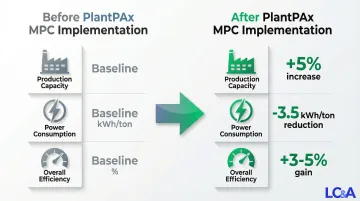
What sets it apart: PlantPAx 5.0 features PlantPAx MPC, a Logix-based model predictive control module derived from Pavilion8 technology that delivers 3-5% efficiency gains. A cement industry case study noted a 5% increase in production and 3.5 kWh/ton reduction in power consumption. The ability to run MPC directly in ControlLogix hardware brings high-end APC capabilities to the controller layer.
| Key Strengths | Unified process and discrete control, enterprise standardization capabilities, reduced hardware costs |
|---|---|
| Best For | Food & beverage, consumer goods, hybrid manufacturing with both process and discrete operations |
| Notable Features | PlantPAx 5.0 DCS with embedded MPC, FactoryTalk software suite, integrated safety systems |
Schneider Electric (EcoStruxure)
Schneider Electric is a sustainability-focused automation provider emphasizing energy efficiency and IoT integration through their EcoStruxure platform, serving industries prioritizing environmental performance alongside operational optimization.
Notable benefits: In power generation applications, EcoStruxure APC demonstrated a 0.7% efficiency improvement, 15,000 tons per year CO2 reduction, and nearly $700,000 in annual savings for a 400MW plant. The platform integrates with AVEVA PI System for high-fidelity data management and comprehensive energy visibility.
| Key Strengths | Energy efficiency focus, strong IoT integration, sustainability reporting capabilities |
|---|---|
| Best For | Operations with aggressive sustainability goals, power generation, utilities, green manufacturing |
| Notable Features | EcoStruxure Plant platform, energy management suite, AVEVA PI System integration, cloud-based analytics |
ABB (Ability System 800xA)
ABB is an established automation provider offering comprehensive process control with strong remote monitoring capabilities and industry-leading human-machine interface (HMI) design for enhanced operator effectiveness.
Key advantages: System 800xA APC integrates MPC directly into the AC 800M controller, with architecture supporting remote commissioning and application support. The 800xA operator workplace provides integrated faceplates and KPI tables for APC, ensuring operators have full visibility into controller actions for effective remote operations management.
| Key Strengths | Remote monitoring excellence, superior HMI design, strong safety integration |
|---|---|
| Best For | Power generation, mining, metals processing, and geographically distributed operations |
| Notable Features | System 800xA DCS with embedded APC, ABB Ability digital platform, collaborative operations environment |
Lashley Cohen and Associates
Lashley Cohen is a specialized industrial automation integrator with over 35 years of experience designing, manufacturing, and implementing process control solutions across diverse sectors including food & beverage, chemicals, building materials, and water/wastewater treatment.
What sets it apart:
- ISO-9001 certified project management ensures comprehensive oversight from start to finish
- Rockwell Systems Bronze Partner status with certified PE Engineer on staff
- 5,000+ successful projects across 2,000+ clients since 1988
- Documented results include 50% throughput increase for beverage manufacturer
- Deep expertise in water/wastewater treatment facility implementations
| Key Strengths | 35+ years experience, ISO-9001 certified processes, comprehensive lifecycle support, PE Engineer on staff |
|---|---|
| Best For | Regional manufacturers seeking personalized integration services, facilities requiring Rockwell platform expertise, projects needing engineering certification |
| Notable Features | Controls integration, project management services, multi-sector experience across food & beverage, chemicals, water treatment, proactive optimization approach |
Yokogawa Electric
Yokogawa is a Japanese automation leader with strong emphasis on process safety and reliability, offering robust control systems particularly valued in industries with strict safety and regulatory requirements.
Notable benefits: CENTUM VP boasts a 99.99999% (seven nines) availability track record, with its APC platform co-developed with Shell. The system emphasizes integration with ProSafe-RS safety instrumented systems, ensuring optimization does not compromise safety boundaries. Yokogawa maintains dominant presence in LNG, refining, and petrochemicals, particularly in Asia-Pacific markets.
| Key Strengths | Process safety focus, exceptional reliability (99.99999% availability), strong Asia-Pacific presence |
|---|---|
| Best For | Oil & gas, chemicals, pharmaceuticals with strict safety requirements, Asia-Pacific operations, LNG facilities |
| Notable Features | CENTUM VP DCS with proven reliability, ProSafe-RS safety integration, field wireless capabilities |
Averroes.ai
Averroes.ai is an emerging AI-driven process control platform leveraging deep learning and machine learning algorithms for autonomous process optimization, predictive maintenance, and continuous improvement without extensive model development.
Key advantages: Rapid deployment with minimal training requirements and intuitive interface accessible to all staff levels. In semiconductor manufacturing, AI-driven solutions like Averroes can reduce yield detraction by up to 30%. The platform focuses on visual inspection integration and semiconductor-specific challenges, offering highly customizable solutions for varied manufacturing environments.
| Key Strengths | AI-driven optimization, quick setup without complex modeling, intuitive interface, predictive maintenance capabilities |
|---|---|
| Best For | Electronics, semiconductor, operations seeking AI-enhanced control without complex model building |
| Notable Features | Deep learning algorithms, defect classification, virtual metrology, cloud-based deployment options, visual inspection integration |
How We Chose the Best Process Control Companies
Selecting the right process control vendor requires looking beyond marketing claims to evaluate proven performance.
Common mistakes include focusing solely on brand recognition, underestimating integration complexity, or choosing based only on initial cost without considering total cost of ownership.
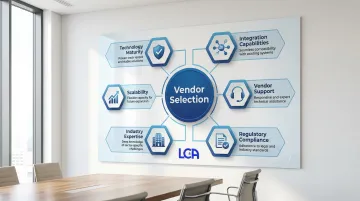
Key evaluation factors include:
- Technology maturity and deployment history - Proven performance in similar applications
- Integration capabilities - Compatibility with existing DCS/SCADA/ERP systems and standard protocols like OPC UA
- Scalability for future growth - Ability to expand from pilot implementations to enterprise-wide deployments
- Vendor support and training - Availability of remote monitoring services and local engineering support
- Industry-specific expertise - References and libraries for your vertical (e.g., Yokogawa for LNG, Rockwell for cement)
- Regulatory compliance capabilities - Safety system integration and documentation requirements
These criteria matter because they tie technical capabilities to measurable business outcomes:
- Reduced variability and improved yield
- Lower energy consumption and operating costs
- Decreased unplanned downtime
- Enhanced safety and regulatory compliance
- Measurable ROI typically achieved within 12-24 months for well-executed implementations
Conclusion
Selecting a process control partner should balance technology capabilities with implementation expertise, vendor support, and alignment with specific operational goals rather than defaulting to the largest brand name.
The vendor landscape includes established DCS incumbents offering embedded APC solutions, specialized software providers delivering platform-agnostic optimization, and regional integrators providing personalized service with deep application expertise.
When evaluating vendors, focus on these critical factors:
- Run pilot projects when possible to assess compatibility and real-world performance
- Evaluate ongoing support capabilities and training programs—model maintenance can represent 50% of initial cost over 5 years if neglected
- Calculate total cost of ownership including implementation, maintenance, and hardware infrastructure
- Verify solutions integrate smoothly with existing infrastructure through standard protocols and proven connectivity
Finding the right implementation partner ensures your process control investment delivers lasting value. For over 35 years, Lashley Cohen and Associates has helped manufacturers across food & beverage, chemicals, building materials, and other sectors optimize their operations through process control system design and implementation. Contact us at (770) 962-0878 or websales@lashleycohen.com to discuss how our ISO-9001 certified approach and proven track record can drive your industrial optimization goals forward.
Frequently Asked Questions
What is advanced process control and how does it differ from basic automation?
APC uses sophisticated algorithms and real-time data analysis to optimize multi-variable processes beyond basic PID control. While basic automation handles regulatory control at the millisecond level, APC operates as a supervisory layer managing multivariable interactions, constraints, and economic optimization every 30 seconds to minutes.
Which industries benefit most from advanced process control systems?
Oil & gas, chemicals, pharmaceuticals, food & beverage, power generation, and water treatment benefit most due to their complex processes and strict quality requirements. The semiconductor segment accounts for nearly 30% of APC market share due to precision control requirements in fabrication processes.
What is the typical ROI timeframe for APC implementation?
Most APC projects achieve positive ROI within 12-24 months through reduced energy consumption, improved yield, and lower operating costs. Best-in-class implementations show payback in 3-9 months, with throughput increases of 2-5% and energy reductions of up to 10%.
How do process control systems integrate with existing plant infrastructure?
Modern APC systems connect to existing DCS, SCADA, and historian systems through standard protocols like OPC UA. Integration complexity varies based on legacy system age, with embedded APC solutions offering simpler integration than server-based architectures.
What's the difference between a DCS and an APC system?
A DCS handles basic regulatory control and monitoring with PID loops at the millisecond level. APC sits above the DCS as a supervisory layer providing advanced optimization, predictive control, and multi-variable coordination, typically executing every 30 seconds to minutes.
Should I choose a global vendor or a regional systems integrator for process control?
Global vendors offer proven platforms for large-scale implementations with extensive R&D resources. Regional integrators like Lashley Cohen provide personalized service, deep application expertise, and responsive local support that are critical for successful operation, model maintenance, and continuous optimization.