Introduction
U.S. manufacturers face a projected shortage of 3.8 million workers by 2033, with 1.9 million positions likely unfilled. Industrial automation and control systems have become essential for bridging this talent gap.
Smart manufacturing and Industry 4.0 now form the foundation manufacturers need to maintain competitive operations despite workforce constraints.
Automation technology partners deliver measurable results: control systems that reduce maintenance costs by up to 40% while improving equipment reliability by 30-50%.
These solutions provide real-time data exchange, predictive maintenance capabilities, and operational cost reductions that help manufacturers optimize production performance while addressing workforce shortages.
TLDR
- Control systems (PLC, SCADA, DCS, MES) transform manufacturing with real-time monitoring and predictive maintenance
- Providers range from global giants (Siemens, Rockwell) to specialized integrators serving specific industries
- Choose partners based on integration expertise, industry certifications, and documented ROI in your sector
- Implementation expertise and ongoing partnership matter more than technology selection alone
Overview of Industrial Automation in Smart Manufacturing
Industrial automation in smart manufacturing uses control systems, information technologies, and electromechanical devices to operate industrial processes with minimal human intervention. These systems transform traditional factories into adaptive, self-optimizing operations that enable data-driven decision making.
This transformation is driving explosive market growth. The global industrial automation market is projected to expand from USD 226.8 billion in 2025 to USD 504.4 billion by 2033, growing at a CAGR of 10.5%. The U.S. market alone is expected to reach USD 85.55 billion by 2030.
Key drivers include severe labor shortages, demand for operational efficiency, and accelerating Industry 4.0 adoption across manufacturing sectors.
Core Control Technologies
Four control technologies form the foundation of smart manufacturing:
- Programmable Logic Controllers (PLCs) control production systems at the machine level, executing discrete control logic with built-in cybersecurity and cloud connectivity
- SCADA systems monitor and control distributed assets across facilities, aggregating data from PLCs to provide centralized visibility and alarm management
- Distributed Control Systems (DCS) handle continuous process control in industries like chemicals and food processing, with distributed control elements for high availability
- Manufacturing Execution Systems (MES) bridge plant floor control and enterprise planning, managing production execution while tracking materials, quality, and OEE in real-time
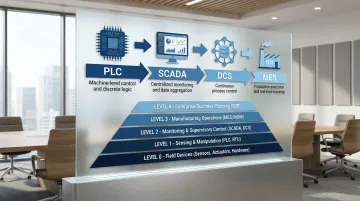
These technologies follow the ISA-95 standard for enterprise-control integration, ensuring seamless communication from field devices through enterprise systems.
Top Industrial Automation Companies and Control Solutions for Smart Manufacturing
The following companies were selected based on market presence, technological innovation, industry certifications, breadth of control solutions, and proven track record in enabling smart manufacturing transformations.
Siemens AG
Siemens is a German-based global leader with a comprehensive automation portfolio including TIA Portal (Totally Integrated Automation), SIMATIC controllers, SCADA systems, and digital twin capabilities. The company serves automotive, pharma, food & beverage, and discrete manufacturing sectors.
Recognized as a 2025 Gartner Magic Quadrant Leader for Industrial IoT Platforms, Siemens delivers integrated smart manufacturing solutions.
What sets Siemens apart:
- Seamless integration from field devices to enterprise systems
- Extensive IIoT capabilities through the Insights Hub platform (formerly MindSphere)
- Strong cybersecurity features following IEC 62443 standards
- Global support network with deep vertical industry expertise
| Attribute | Details |
|---|---|
| Key Control Solutions | SIMATIC PLC/PAC systems, SCADA, DCS, MES integration |
| Smart Manufacturing Capabilities | Digital twin technology, predictive maintenance, cloud connectivity, edge computing |
| Industry Focus | Automotive, pharmaceuticals, food & beverage, discrete manufacturing |
Rockwell Automation
Rockwell Automation is a US-based automation leader known for Allen-Bradley control products, FactoryTalk software suite, and comprehensive smart manufacturing solutions. The company serves process and discrete industries with particular strength in North American markets.
Their extensive PartnerNetwork program connects manufacturers with certified system integrators.
Key strengths:
- Deep integration between hardware and software through the FactoryTalk ecosystem
- Strong partner network including specialized system integrators
- Extensive training resources and support documentation
- Connected enterprise architecture linking plant floor to top floor
| Attribute | Details |
|---|---|
| Key Control Solutions | Allen-Bradley PLCs, FactoryTalk SCADA/MES, GuardLogix safety systems |
| Smart Manufacturing Capabilities | Connected enterprise architecture, augmented reality for maintenance, analytics through FactoryTalk Analytics |
| Industry Focus | Oil & gas, mining, food & beverage, automotive, life sciences |
ABB Ltd
ABB is a Swiss-based technology leader providing robotics, motion control, industrial automation, and electrification products. The company has particular strength in process industries and integration of automation with power systems.
Ranked #1 in DCS market share for 19+ consecutive years by ARC Advisory Group, ABB dominates process automation.
ABB's distinctive capabilities:
- Combination of robotics and automation in a single portfolio
- ABB Ability™ digital platform for IIoT applications
- Extensive experience in energy-intensive industries
- Focus on sustainability and energy efficiency in manufacturing operations
| Attribute | Details |
|---|---|
| Key Control Solutions | System 800xA DCS, AC 800M controllers, robotics integration, electrical distribution |
| Smart Manufacturing Capabilities | ABB Ability™ platform, collaborative robots (cobots), energy management, digital services |
| Industry Focus | Oil & gas, chemicals, pulp & paper, utilities, metals, mining |
Lashley Cohen and Associates
Lashley Cohen and Associates is a specialized controls integrator with over 35 years of experience (since 1988) providing comprehensive automation solutions across diverse manufacturing sectors. With ISO-9001 certification and Rockwell Systems Bronze Partner status, the firm has completed 5000+ successful projects for 2000+ clients.
The company delivers controls integration, project management, and engineering services tailored to each facility's unique requirements.
Core differentiators:
- Proven track record with 5000+ completed projects
- Dedicated PE Engineer on staff
- Proactive approach aligning technical solutions with long-term business goals
- Comprehensive lifecycle support from design through implementation and optimization
- Fully customized engineering services for each facility
| Attribute | Details |
|---|---|
| Key Control Solutions | PLC/SCADA integration, HMI development, system design, project management services |
| Smart Manufacturing Capabilities | Data-driven decision-making systems, real-time monitoring, production optimization, legacy system modernization |
| Industry Focus | Food & beverage, consumer goods, building materials, chemicals, metals, water/wastewater |
Schneider Electric
Schneider Electric is a French-based global specialist in energy management and automation offering the EcoStruxure platform that connects OT and IT systems. The company serves industries focused on sustainability and energy efficiency alongside production optimization.
Their universal automation approach promotes hardware-agnostic software based on IEC 61499.
Schneider Electric's advantages:
- Strong focus on sustainability and energy management integrated with automation
- Open architecture supporting multiple protocols including OPC UA for legacy system integration
- Extensive edge control and IIoT capabilities
- Comprehensive cybersecurity features across all automation layers
| Attribute | Details |
|---|---|
| Key Control Solutions | Modicon PLCs, EcoStruxure SCADA/MES, Triconex safety systems |
| Smart Manufacturing Capabilities | EcoStruxure platform for IIoT, edge analytics, energy optimization, AR/VR for operations |
| Industry Focus | Food & beverage, water/wastewater, pharmaceuticals, data centers, buildings |
Emerson
Emerson is a US-based automation solutions provider specializing in process automation through DeltaV DCS and discrete automation through Machine Automation Solutions. The company has particular strength in continuous process industries requiring precise control and reliability.
Named 2026 Industrial IoT Company of the Year, Emerson leads in digital transformation.
Emerson's competitive edge:
- Deep process industry expertise with focus on operational certainty
- Plantweb digital ecosystem for asset performance management
- Strong focus on safety and reliability in critical processes
- Comprehensive consulting services for digital transformation initiatives
| Attribute | Details |
|---|---|
| Key Control Solutions | DeltaV DCS, PACSystems PLCs, SCADA, asset management software |
| Smart Manufacturing Capabilities | Plantweb digital ecosystem, predictive analytics, wireless sensor networks, mobile operations |
| Industry Focus | Oil & gas, refining, chemicals, life sciences, power generation |
Key Technologies Enabling Smart Manufacturing Through Industrial Automation
Industrial Internet of Things (IIoT) Connectivity
Modern control systems leverage IIoT to connect machines, sensors, and devices, creating comprehensive data collection that enables real-time visibility, predictive maintenance, and data-driven optimization. According to IoT Now research, 92% of enterprises report positive ROI from IoT implementations.
Leading platforms enable this transformation:
- Siemens Insights Hub organizes data from OT, IT, and engineering systems
- ABB Genix contextualizes cross-system information to unlock operational value
- Real-time connectivity transforms isolated machines into integrated production ecosystems
IIoT connectivity allows every asset to communicate status, performance, and potential issues as they happen.
Edge Computing and Cloud Integration
Distributed processing architectures balance real-time control with advanced analytics. Edge computing processes data locally near machines to ensure low latency and reduce bandwidth.
This local processing is critical for immediate control decisions and anomaly detection. Cloud computing handles heavy analytics, long-term data storage, and AI model training.
Manufacturers are adopting hybrid architectures as the standard. Edge devices handle immediate execution while cloud platforms manage fleet-wide optimization and predictive modeling across multiple facilities.
Predictive Maintenance (PdM)
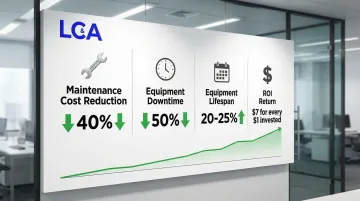
Predictive maintenance uses AI and IoT sensors to predict failures before they occur, delivering exceptional ROI. Companies can realize a $7 return for every $1 spent according to TechRxiv research on PdM implementations.
Predictive maintenance uses AI and IoT sensors to predict failures before they occur, delivering exceptional ROI. Companies can realize a $7 return for every $1 spent according to TechRxiv research on PdM implementations.
Benefits include:
- Reduces maintenance costs by 40%
- Decreases equipment downtime by 50%
- Extends equipment lifespan by 20-25%
- Prevents catastrophic failures through early warning systems
Cybersecurity in Industrial Control Systems
Increased connectivity brings increased risk. The ISA/IEC 62443 standard provides a comprehensive framework for defense-in-depth. It segments networks into zones and conduits to limit attack spread. Modern automation vendors prioritize security features including encrypted communications, role-based access control, and continuous vulnerability monitoring to protect manufacturing operations from cyber threats.
How to Choose the Right Industrial Automation Partner
Assess Technical Capability and Industry Expertise
Verify that the provider has proven experience in your specific industry sector with understanding of your production processes, regulatory requirements, and operational challenges. Request case studies and customer references from similar applications to validate their expertise.
Look for partners who demonstrate deep knowledge of your industry's unique requirements, whether that's FDA compliance in pharmaceuticals, food safety in processing, or hazardous area classifications in chemicals.
Evaluate Certifications and Quality Standards
Confirm essential credentials that demonstrate commitment to quality and best practices:
- ISO 9001: Documented quality management system, often requirement for regulated industries
- Vendor partnerships: Rockwell, Siemens partner tiers indicating training and technical support levels
- Professional engineer licensing: PE certification where applicable for design authority
- Industry standards: ISA CAP (Certified Automation Professional) or CCST (Certified Control Systems Technician) credentials verifying automation skills
Consider Integration and Lifecycle Support
Verify the provider's ability to integrate with existing equipment and enterprise systems using modern protocols like OPC UA for legacy connectivity.
Evaluate their approach to training your team, ongoing support models, and commitment to long-term partnership beyond initial implementation.
The best partners provide comprehensive lifecycle support from initial design through optimization and modernization as your needs evolve.
Analyze Total Cost of Ownership Beyond Initial Price
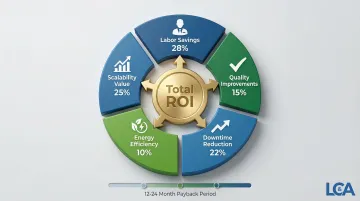
Facility size and scope significantly affect project costs. Small PLC/HMI upgrades typically range from $50,000 to $250,000, while full DCS/MES implementations for medium-to-large plants can exceed $1 million to $5 million. However, successful automation projects typically achieve ROI payback in 12-24 months through labor reduction, quality improvements, and downtime minimization.
Calculate ROI based on:
- Labor savings from automation
- Quality improvements reducing scrap and rework
- Downtime reduction through predictive maintenance
- Energy efficiency gains
- Scalability for future expansion
Review Project Management and Implementation Methodology
Understand their approach to project planning, risk management, testing and commissioning processes, and ability to minimize disruption to ongoing operations during implementation.
Look for structured methodologies, clear communication protocols, and proven change management processes that ensure smooth transitions.
Conclusion
Selecting the right industrial automation partner requires balancing technical capability, industry expertise, certifications, and long-term support—not just choosing the biggest brand name or lowest initial cost.
The most successful partnerships combine deep technical knowledge with genuine understanding of your operational goals and industry challenges. Your partner should integrate solutions seamlessly with existing systems and provide ongoing optimization support as your needs evolve.
The investment in automation delivers measurable returns through reduced labor costs, improved quality, minimized downtime, and enhanced competitiveness.
For manufacturers seeking controls integration expertise, Lashley Cohen and Associates has served industrial facilities since 1988 with ISO-9001 certified processes and comprehensive automation solutions tailored to your industry. Contact them at (770) 962-0878 or websales@lashleycohen.com to discuss how they can enhance your operational performance and guide your smart manufacturing journey.
Frequently Asked Questions
What is the difference between industrial automation and smart manufacturing?
Industrial automation uses control systems to operate machinery with minimal human intervention. Smart manufacturing builds on this foundation by adding IIoT connectivity, data analytics, and AI to create self-optimizing production systems.
Which control system is best for small to medium manufacturing facilities?
PLC-based systems with SCADA visualization offer the best balance of capability, cost, and scalability for most SME manufacturers. The choice depends on your operation type—discrete manufacturing typically uses PLCs, while continuous process industries may need distributed control systems.
How much does industrial automation implementation typically cost?
Small automation projects start around $50,000-$100,000, while comprehensive smart manufacturing transformations range from $500,000 to several million dollars. Most projects deliver ROI within 2-4 years through reduced labor costs, improved quality, and decreased downtime.
What certifications should I look for in an automation systems integrator?
Look for ISO-9001 certification for quality management, vendor partnerships (like Rockwell or Siemens partner status), and PE (Professional Engineer) licensing. These credentials demonstrate proven expertise—for example, Lashley Cohen holds ISO-9001 certification and Rockwell Bronze Partner status.
Can existing equipment be integrated into a smart manufacturing system?
Yes, you can integrate most existing equipment through retrofit sensors, protocol converters, and edge devices that enable legacy machines to communicate with modern control systems. Very old equipment may require replacement for full capabilities.
What is the typical ROI timeline for industrial automation investments?
Most manufacturers see ROI within 2-4 years through reduced labor costs, decreased downtime, and improved quality. High-impact applications like predictive maintenance can deliver returns in under 12 months.