Introduction
U.S. manufacturers face a labor crisis: a persistent 3.0% job vacancy rate across 15.6 million workers means facilities can't fill shifts manually. Automation has become essential, not optional.
The business case is clear. Smart automation cuts unit costs by 3.5%, boosts throughput by 6%, and reduces unplanned downtime by 25%. These efficiency gains explain why the U.S. industrial automation market is projected to reach $54 billion in 2025, fueled by chronic labor shortages, e-commerce fulfillment pressure, and advances in robotics and control systems.
This article profiles the top 10 industrial automation companies operating in the USA for 2026—from global robotics giants to specialized domestic integrators. We'll cover selection criteria, what makes each stand out, and how to choose the right partner for your facility's unique needs.
TL;DR
- U.S. manufacturers are automating to address labor shortages, with the market reaching $54 billion in 2025
- Top providers range from robotics manufacturers (FANUC, ABB) to PLC specialists (Rockwell, Siemens) and systems integrators
- Evaluate vendors on innovation track record, local support availability, relevant certifications, and documented ROI
- Expect payback within 1.3-3 years alongside measurable efficiency improvements
Overview of Industrial Automation in the USA
Industrial automation uses control systems, robotics, and information technologies to handle manufacturing processes with minimal human intervention.
The U.S. market was valued at $47.04 billion in 2024 and is projected to grow at a 10% CAGR through 2030 [SOURCE_NEEDED], fueled by e-commerce fulfillment demands, precision requirements, and Industry 4.0 adoption.
Key market drivers include:
- Manufacturing vacancy rates remain at 3.0% [SOURCE_NEEDED], making automation essential to address persistent labor shortages
- Smart manufacturing reduces costs by over 10% and improves OEE by 11% [SOURCE_NEEDED] through optimized processes
- 92% of manufacturers [SOURCE_NEEDED] view automation as the primary competitiveness driver over the next three years
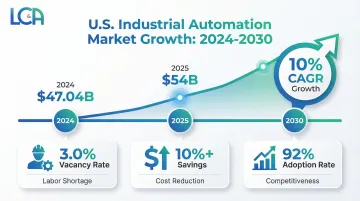
These companies were selected based on technological capabilities, U.S. market presence, customer satisfaction, and innovation track record in advancing manufacturing automation.
Top 10 Industrial Automation Companies in the USA
We selected these companies based on technological innovation, U.S. market presence, customer satisfaction, breadth of solutions, and proven track records. This list includes both global giants with strong U.S. operations and specialized domestic providers offering tailored expertise.
Rockwell Automation
Milwaukee-based Rockwell Automation, founded in 1903, is the leading U.S. automation provider.
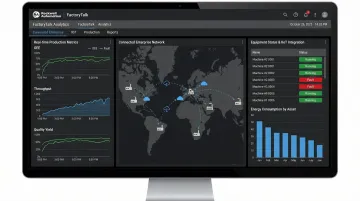
Their core offerings include Allen-Bradley PLCs, PowerFlex drives, and the FactoryTalk software suite for digital transformation.
Differentiators:
- Controls approximately 42% of the North American factory automation market
- FactoryTalk analytics platform enables connected enterprise and IIoT integration
- Extensive U.S.-based support network with comprehensive training and certification programs
- Installed Base Evaluation services help identify obsolescence risks and plan modernization
| Key Products | Primary Industries Served | Competitive Advantages |
|---|---|---|
| Allen-Bradley PLCs and drives, FactoryTalk software suite, industrial networking solutions | Automotive, food & beverage, life sciences, oil & gas, metals | Largest installed base in North America, integrated hardware/software ecosystem, strong partner network |
Siemens USA
Operating in the U.S. since the 1950s with digital industries headquarters in Alpharetta, GA, Siemens offers SIMATIC controllers, TIA Portal software, digital twin technology, and MES systems. The company has invested over $10 billion in the U.S. market over two decades.
Differentiators:
- Totally Integrated Automation (TIA) philosophy connects all automation layers seamlessly
- Advanced digital twin and simulation capabilities optimize processes before implementation
- Comprehensive portfolio spanning field devices to enterprise systems
- 45,000 employees across U.S. operations
| Key Products | Primary Industries Served | Competitive Advantages |
|---|---|---|
| SIMATIC S7 PLCs, TIA Portal software, SINUMERIK CNC systems, digital twin solutions | Automotive, pharmaceuticals, discrete manufacturing, process industries | End-to-end digitalization, seamless OT/IT integration, global scale with local support |
Honeywell Process Solutions
Charlotte-based Honeywell brings deep process automation expertise dating back to 1885. The company specializes in the Experion DCS platform, advanced process control, safety systems, and industrial cybersecurity solutions.
Differentiators:
- Deep expertise in process industries with proven reliability in mission-critical applications
- Forge IIoT platform enables connected operations and predictive analytics
- Strong safety and cybersecurity focus with integrated safety instrumented systems
- Experion PKS integrates DCS with advanced applications for improved business agility
| Key Products | Primary Industries Served | Competitive Advantages |
|---|---|---|
| Experion DCS, Forge IIoT platform, advanced process control (APC), safety instrumented systems | Oil & gas, chemicals, pulp & paper, power generation, mining | Process industry expertise, integrated safety and control, cybersecurity leadership |
FANUC America
Headquartered in Rochester Hills, MI, FANUC America is the largest robot installer in the Americas.
The company has installed over 1 million robots globally, offering industrial robots, CNC systems, collaborative robots, and factory automation solutions.
Differentiators:
- Industry-leading reliability with mean time between failures (MTBF) exceeding 80,000 hours
- Comprehensive service network across the U.S. ensures rapid response
- Strong presence in automotive and electronics with proven high-volume solutions
- Integrated CNC and robotics capabilities for complete manufacturing automation
| Key Products | Primary Industries Served | Competitive Advantages |
|---|---|---|
| Industrial robots (welding, material handling, assembly), FANUC CNC systems, collaborative robots | Automotive, aerospace, electronics, metal fabrication, plastics | Proven reliability (MTBF >80,000 hours), extensive robot portfolio, integrated CNC and robotics |
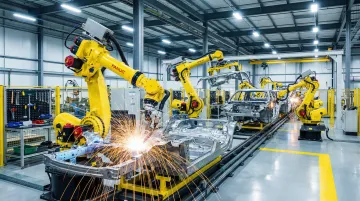
ABB Robotics USA
Based in Auburn Hills, MI, ABB Robotics is part of the Swiss-based ABB Group. Product lines include industrial robots, collaborative robots, machine automation, and comprehensive digital solutions including RobotStudio simulation software.
Differentiators:
- Strong collaborative robotics portfolio with YuMi and GoFa lines for safe human-robot interaction
- RobotStudio digital twin and simulation tools reduce deployment risk
- Flexible automation solutions ideal for high-mix production environments
- IRB 760 palletizing robot achieves 880 cycles per hour at full load
| Key Products | Primary Industries Served | Competitive Advantages |
|---|---|---|
| IRB industrial robots, YuMi collaborative robots, RobotStudio simulation, machine automation controllers | Electronics, automotive, logistics, food & beverage, pharmaceuticals | Cobot innovation, digital twin technology, flexible automation solutions |
KUKA Robotics USA
Michigan-based KUKA Robotics brings German engineering expertise with strong automotive heritage. The portfolio spans industrial robots, AGVs/AMRs, system integration, and the iiQKA ecosystem for connected manufacturing.
Differentiators:
- Proven high-volume automotive solutions with decades of industry experience
- Integrated AGV/AMR capabilities streamline material handling
- iiQKA operating system connects manufacturing equipment for Industry 4.0 readiness
- KR QUANTEC series offers versatility across market segments from foundry to medical applications
| Key Products | Primary Industries Served | Competitive Advantages |
|---|---|---|
| KR QUANTEC robots, LBR iiwa collaborative robot, KUKA AMRs, iiQKA operating system | Automotive, aerospace, metal fabrication, electronics, consumer goods | Automotive expertise, integrated mobile robotics, flexible manufacturing systems |
Emerson Automation Solutions
Headquartered in St. Louis, MO, Emerson is a leader in process automation. Core products include DeltaV DCS, PACSystems PLCs, asset management tools, and Fisher control valves. Recent acquisitions of National Instruments and AspenTech strengthen their software capabilities.
Differentiators:
- Strong in hybrid industries requiring both process and discrete control
- Comprehensive asset management and predictive maintenance tools reduce unplanned downtime
- Operational certainty consulting approach optimizes total plant performance
- DeltaV Electronic Marshalling with CHARMs technology reduces installation complexity
| Key Products | Primary Industries Served | Competitive Advantages |
|---|---|---|
| DeltaV DCS, PACSystems PLCs, AMS asset management, Fisher control valves | Chemical, life sciences, food & beverage, power, water/wastewater | Hybrid control expertise, asset optimization, operational certainty methodology |
Mitsubishi Electric Automation USA
With Illinois headquarters, Mitsubishi Electric offers MELSEC PLCs, servo systems, HMIs, industrial robots, and CNC systems. Their e-F@ctory concept provides a framework for smart manufacturing implementation.
Differentiators:
- Integrated motion control and robotics simplify system design
- Compact and modular designs ideal for space-constrained applications
- e-F@ctory smart manufacturing framework connects factory floor to enterprise systems
- High-quality factory automation components with proven reliability
| Key Products | Primary Industries Served | Competitive Advantages |
|---|---|---|
| MELSEC iQ-R PLCs, MELSERVO servo drives, MELFA robots, CNC systems | Packaging, automotive, semiconductor, material handling, machine builders | Integrated motion solutions, compact designs, e-F@ctory smart manufacturing framework |
Yaskawa America
Headquartered in Miamisburg, OH, Yaskawa's Motoman robotics division offers the broadest robot product line in the Americas with over 170 models. The company also provides Sigma servo drives, machine controllers, and the Cockpit IoT platform.
Differentiators:
- Over 600,000 Motoman robots and 35 million inverter drives installed globally
- Industry-leading servo technology with Sigma-7 drives
- Strong application expertise in arc welding and material handling
- Over 1 million drives installed in North America alone
| Key Products | Primary Industries Served | Competitive Advantages |
|---|---|---|
| Motoman robots, Sigma-7 servo drives, MP machine controllers, Cockpit IoT platform | Automotive, metal fabrication, food & beverage, packaging, plastics | Broadest robot portfolio, servo technology leadership, application expertise |
Lashley Cohen and Associates
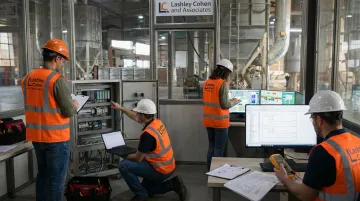
Georgia-based since 1988, Lashley Cohen and Associates brings 35+ years of specialized controls integration and engineering services. Services include PLC programming, HMI/SCADA development, system integration, and project management across diverse industries.
Differentiators:
- ISO-9001 certified processes ensure quality delivery from project start to finish
- Rockwell Systems Bronze Partner with deep Allen-Bradley expertise
- Certified PE engineer on staff for complex compliance requirements
- Proven track record with 5,000+ projects across food & beverage, consumer goods, and building materials
- Client relationships average over 12 years with rapid response times
| Key Services | Primary Industries Served | Competitive Advantages |
|---|---|---|
| Controls integration, PLC/HMI programming, system design, project management, commissioning support | Food & beverage, consumer goods, building materials, paper/printing, general manufacturing | 35+ years experience, ISO-9001 certified, Rockwell partnership, PE engineer on staff, 2,000+ satisfied clients |
How We Chose the Best Industrial Automation Companies
Common Selection Mistakes
Manufacturers often focus solely on brand recognition or lowest initial price without considering:
- Total cost of ownership: Integration, training, and maintenance often exceed hardware costs
- Support infrastructure: Local service availability determines downtime duration
- Integration complexity: How new systems connect to existing MES/ERP platforms
- Long-term scalability: Can the solution grow with your operation?
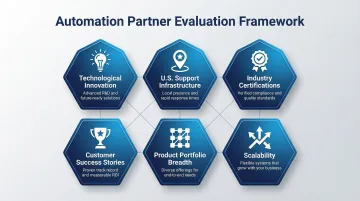
Our Evaluation Framework
To identify the top industrial automation companies, we evaluated each provider across six key dimensions:
- Technological innovation and R&D investment in Industry 4.0 capabilities
- U.S.-based support and service infrastructure for rapid response times
- Industry certifications and compliance capabilities (ISO-9001, UL508A, ISA/IEC 62443)
- Proven customer success stories with documented ROI and performance improvements
- Breadth of product portfolio to address diverse automation needs
- Scalability from single-line to enterprise-wide implementations
The Right Partner Depends on Your Needs
The best automation partner depends on your specific application requirements, existing infrastructure, industry regulations, and future growth plans—not just company size or global market share.
A global robotics giant may excel at high-volume automotive applications. A specialized integrator might better serve complex batch processing or legacy system modernization.
Conclusion
These 10 companies represent the leading edge of industrial automation in the USA for 2026. From global technology giants like Siemens and FANUC to specialized domestic providers like Lashley Cohen and Associates, each brings unique strengths to different manufacturing challenges.
The "Big Four" robotics companies (FANUC, ABB, KUKA, Yaskawa) collectively hold 62% of the global market, while PLC leaders like Rockwell and Siemens dominate control systems. Process automation specialists like Honeywell and Emerson excel in mission-critical applications.
Successful automation requires careful evaluation of technology capabilities, support infrastructure, integration expertise, and alignment with long-term operational goals.
Modern automation projects deliver payback in 1.3 to 3 years and ROI exceeding 250% in some applications. The investment case is compelling—but only when paired with the right partner.
For manufacturers seeking controls integration expertise, Lashley Cohen and Associates brings 35+ years of experience as a Rockwell Systems Bronze Partner with ISO-9001 certified processes and over 5000 completed projects.
Contact us at (770) 962-0878 to discuss your automation needs.
Frequently Asked Questions
What are the largest industrial automation companies?
In the USA, Rockwell Automation leads with approximately 42% of the North American market, while Honeywell and Emerson dominate process automation. Globally, Siemens, ABB, and Schneider Electric are the largest by revenue.
Who are the big 4 in the industrial robotics industry?
FANUC, ABB, KUKA, and Yaskawa collectively hold over 62% of global market share. All four maintain extensive US operations with combined installations exceeding 2 million robots worldwide.
What is the difference between a robotics manufacturer and a controls integrator?
Manufacturers like FANUC and ABB design and build robot hardware. Controls integrators like Lashley Cohen program and integrate automation systems into production lines, working with multiple hardware vendors to deliver complete tailored solutions.
How do I determine which automation company is right for my facility?
Evaluate industry experience, equipment compatibility, required certifications (FDA, UL508A), regional support availability, and total cost of ownership. Consider whether you need hardware, integration services, or both, and request references from similar applications.
What certifications should I look for in an automation provider?
Look for ISO-9001 certification, manufacturer partnerships (Rockwell/Siemens Partner), and PE engineering credentials. Industry-specific needs may require FDA compliance, UL508A panel shop certification, or ISA/IEC 62443 cybersecurity standards.
What is the typical ROI timeline for industrial automation projects?
ROI typically ranges from 1.3 to 3 years depending on application. Robotics platforms average 1.3-year payback with 4.7x ROI. Calculate both hard costs (labor, throughput) and soft costs (quality, downtime) for accurate projections.