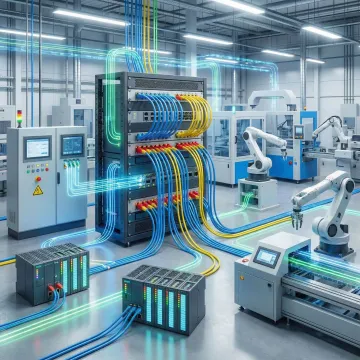
What is industrial networking?
Industrial networking refers to the communication infrastructure that connects machines, sensors, controllers, and other devices in manufacturing environments. It enables real-time data exchange, centralized monitoring and control, and integration of automation systems including PLCs, SCADA, and HMIs. Industrial networks use protocols like EtherNet/IP, Profinet, and Modbus to ensure reliable, deterministic communication in harsh production environments.
What are the examples of industrial IoT solutions?
Industrial IoT solutions include predictive maintenance systems that monitor equipment health, real-time production tracking and OEE monitoring, automated quality control with sensor integration, remote asset monitoring and control, energy management systems, inventory tracking with RFID integration, and connected supply chain logistics. These solutions leverage networked sensors and controllers to collect data that drives operational insights and efficiency improvements.
What are key features of Cisco industrial networking solutions?
Cisco industrial networking solutions feature ruggedized hardware designed for harsh environments, advanced cybersecurity with threat defense and segmentation, high reliability with redundant communication paths, real-time communication protocols, seamless IT/OT network convergence, centralized network management, and scalability for expanding operations. These features ensure secure, reliable connectivity that meets the demanding requirements of modern manufacturing facilities.
How long does industrial network implementation typically take?
Implementation timelines vary based on facility size and complexity, but typically range from 2-8 weeks for small to medium installations and 2-6 months for large-scale deployments. Our ISO-9001 certified project management process includes detailed planning, phased implementation to minimize production disruption, and comprehensive testing before final commissioning to ensure your timeline and operational requirements are met.
What security measures protect industrial networks from cyber threats?
We implement multi-layered security including industrial firewalls, network segmentation separating IT and OT systems, encrypted communication protocols, role-based access controls, continuous monitoring for threats, regular security updates, and employee training. These comprehensive measures protect your critical manufacturing systems from unauthorized access, malware, and cyber attacks while maintaining operational availability.
Can you integrate new networking with our existing automation systems?
Yes, our team specializes in integrating new industrial networking infrastructure with legacy systems and existing automation equipment. We work with all major PLC brands, SCADA platforms, and industrial protocols. Our experienced engineers assess your current systems, design compatible network architectures, and ensure seamless integration while maintaining production continuity throughout the upgrade process.
What ongoing support and maintenance do you provide?
We offer comprehensive ongoing support including proactive network monitoring, preventive maintenance, rapid troubleshooting and repair services, security updates and patches, performance optimization, system expansion services, and technical training for your staff. Our dedicated support team ensures your industrial network infrastructure maintains peak performance and reliability throughout its operational lifecycle.
How do industrial networks improve manufacturing efficiency?
Industrial networks improve efficiency by enabling real-time visibility into production processes, facilitating predictive maintenance that reduces downtime, supporting data-driven decision making, automating quality control and reporting, optimizing inventory and supply chain logistics, and allowing remote monitoring and control. Connected systems provide the foundation for continuous improvement and Industry 4.0 transformation initiatives.