This guide provides a comprehensive understanding of Process Control Systems (PCS)—covering types, components, benefits, and selection criteria—to help you optimize your manufacturing operations and achieve measurable ROI.
TLDR:
- Process control systems automate industrial processes through continuous feedback loops, reducing errors and improving efficiency
- Three main architectures—DCS, PLC, and SCADA—serve different scales and process types
- Modern PCS delivers 12-24 month payback through reduced waste, energy savings, and improved throughput
- Successful implementation requires matching system architecture to process complexity and working with experienced integrators
What Are Process Control Systems?
Process Control Systems (PCS) are integrated technologies that monitor, control, and optimize industrial manufacturing processes using control theory and automation. At their core, these systems function to establish and maintain process performance within specification limits.
The Feedback Control Loop
Every PCS operates through a continuous four-step feedback loop:
- Measure – Sensors detect current process variables (temperature, flow, pressure, level)
- Compare – Controllers compare measurements against desired setpoints to calculate error
- Compute – Control algorithms (like PID) determine necessary corrections
- Correct – Actuators adjust the process to reduce error
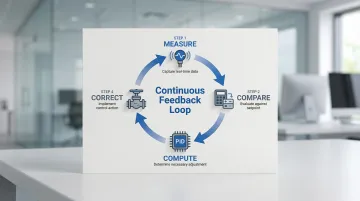
This closed-loop approach differs fundamentally from manual control. Key advantages include:
- Real-time monitoring and automated adjustments
- Data-driven decision making
- Management of complex multi-variable processes without constant human intervention
Real-World Applications
These feedback principles translate directly into manufacturing environments across industries:
- Chemical reactors – Maintaining precise temperature control to ensure consistent product quality and prevent dangerous thermal runaway
- Oil refineries – Regulating pressure across distillation columns to optimize separation efficiency
- Food processing – Managing flow rates in beverage filling lines to maximize throughput while minimizing waste
Evolution to Modern Systems
The field has progressed from simple pneumatic and mechanical controls to advanced digital systems. Modern platforms now integrate Artificial Intelligence and Machine Learning capabilities.
This transforms reactive control into predictive optimization. Manufacturers reduce unplanned downtime and maintenance costs through early fault detection.
Types of Process Control Systems
Selecting the right architecture is critical for operational success. Feedback mechanisms, scale, and primary function distinguish one system type from another.
Open-Loop vs. Closed-Loop Control
| Feature | Open-Loop Control | Closed-Loop Control |
|---|---|---|
| Feedback | No feedback used; action independent of output | Uses feedback to continuously correct errors |
| Accuracy | Inaccurate if conditions change | Maintains accuracy despite disturbances |
| Stability | Generally stable but cannot self-correct | Can become unstable if improperly tuned |
| Applications | Simple timers, conveyor speeds, non-critical dosing | Temperature, pressure, flow control in continuous processes |
Distributed Control Systems (DCS)
DCS architecture distributes control functions across multiple controllers throughout the plant, connected through networked communication with centralized monitoring.
When to use DCS:
- Large-scale continuous processes (chemical plants, refineries, power generation)
- Operations requiring high reliability and native redundancy
- Complex processes with hundreds or thousands of control loops
Key advantages:
- Redundancy reduces single points of failure
- Scalability supports plant expansion
- Integrated alarm management and unified database
The DCS market reached $47.04 billion in 2024, growing at 10.6% annually, driven primarily by oil & gas and power generation sectors.
Programmable Logic Controllers (PLC)
PLCs are ruggedized industrial computers optimized for high-speed discrete control, offering programming flexibility and deterministic scan cycles.
When to use PLCs:
- Smaller processes and discrete manufacturing
- Batch operations and machine control
- High-speed assembly and packaging lines
Modern PLCs (often called PACs) now handle complex analog control, motion, and safety functions previously reserved for DCS.
Lashley Cohen has deployed Rockwell ControlLogix platforms across diverse applications, from geothermal energy systems with 1,500 HP motor controls to complex batching systems supporting 2,000 recipes in rubber manufacturing.
Supervisory Control and Data Acquisition (SCADA)
While PLCs manage local control, SCADA provides supervisory-level monitoring across geographically dispersed processes. It sits atop hardware controllers (PLCs/RTUs) to deliver data acquisition, historical trending, and centralized alarm handling.
Typical SCADA applications:
- Utilities and water treatment facilities
- Pipeline monitoring across vast distances
- Building management systems
- Wind farms and distributed energy resources
Modern SCADA leverages cloud computing and edge devices to centralize security and operations, enabling remote monitoring of assets that may span hundreds of miles.
Hybrid Architectures
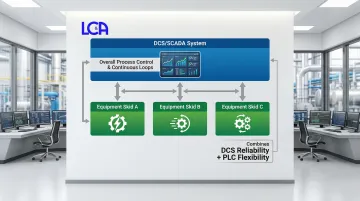
The strict separation between PLC and DCS is fading. Best practice now employs tiered architectures:
- Tier 1: DCS or powerful SCADA manages overall process and continuous loops
- Tier 2: PLCs handle high-speed, dedicated control of specific equipment skids
This approach combines DCS reliability with PLC flexibility and speed.
Key Components and Hardware of Process Control Systems
Sensors and Instrumentation
Sensors continuously measure process variables, providing the foundational data that drives control decisions. Accuracy requirements, operating range, and environmental conditions determine sensor selection.
Common sensor types:
- Temperature – Thermocouples and RTDs for process heating/cooling
- Pressure – Transducers for material balance and safety monitoring
- Flow – Meters for liquid and gas measurement
- Level – Sensors for tank and vessel monitoring
- Analytical – pH, conductivity, and composition analyzers
Modern smart sensors communicate via digital protocols, providing diagnostic data alongside process measurements to simplify troubleshooting.
Controllers and Processing Units
Controllers receive sensor data, execute control algorithms, and send commands to actuators based on the control strategy.
Controller types:
- Single-loop controllers for simple applications
- Multi-loop controllers for related process variables
- PLC processors for discrete and sequential control
- DCS control modules for complex continuous processes
Control Algorithms:
PID (Proportional-Integral-Derivative) remains the workhorse of industrial control, eliminating steady-state error and anticipating future deviations to maintain setpoints.
Model Predictive Control (MPC) uses dynamic process models to predict future behavior and optimize control actions. It's superior to PID for complex, multivariable processes with significant interactions between variables.
Actuators and Final Control Elements
Actuators execute control commands by physically adjusting process variables in response to controller signals.
Common actuator types:
- Control valves – Regulate fluid flow based on controller signals
- Variable frequency drives (VFDs) – Control motor speed and torque; modern regenerative drives capture braking energy to reduce power costs
- Dampers – Adjust airflow in combustion and HVAC systems
- Positioners – Ensure precise valve positioning
Proper actuator sizing, response time, and fail-safe design are essential for process stability and safety.
Human-Machine Interface (HMI) and SCADA
HMI provides operators with a window into the process through graphical displays, real-time data visualization, alarm management, and manual control capabilities.
Typical HMI features:
- Animated process graphics showing equipment status
- Real-time and historical trend displays
- Prioritized alarm summaries
- Historical data for troubleshooting
- Batch recipe management
HMI plays a critical role in operator training, enabling personnel to understand process behavior before making adjustments.
Communication Networks and Integration
Industrial networks connect sensors, controllers, HMI, and enterprise systems for seamless data flow.
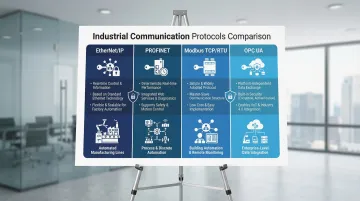
Common industrial protocols:
| Protocol | Key Characteristics | Typical Use Case |
|---|---|---|
| EtherNet/IP | High-speed, time-critical data transfer using CIP | Connecting PLCs to I/O, drives, controllers in discrete manufacturing |
| PROFINET | High speed with integrated safety (PROFIsafe) | Factory automation requiring tight synchronization |
| Modbus TCP/RTU | Simple, vendor-neutral, widely supported | Legacy device connectivity, energy meters |
| OPC UA | Platform-independent, secure, scalable | Bridging OT and IT systems, IIoT integration |
Modern protocols like OPC UA and PROFINET include robust security features (encryption, authentication) to meet IEC 62443 standards, addressing vulnerabilities of older serial protocols. Proper network architecture and protocol selection are critical—experienced integration partners can design secure, scalable communication infrastructures that support both current operations and future expansion.
Benefits and ROI of Process Control Systems
Operational Improvements
Downtime Reduction: Integrated control architectures enable real-time fault detection and swift corrective actions, reducing unplanned downtime by up to 30%.
Energy Efficiency: VFDs deliver dramatic results in energy reduction:
- 60% energy cost reduction in plastics manufacturing
- $1,500+ per week savings in water pumping applications
- 15-20% efficiency gains across motor-driven processes
Throughput Optimization: Automated systems increase production output by 30-35% by optimizing cycle times and reducing manual interventions.
Lashley Cohen achieved a remarkable 50% throughput increase for a beverage manufacturer, taking a $3 million filling line from 1,100 to 1,600 containers per minute through systematic process control optimization.
Quality Consistency: Automated control eliminates human variability, reducing waste and rework while ensuring products consistently meet specifications.
Beyond production metrics, process control systems enhance workplace safety and regulatory compliance.
Safety and Compliance Advantages
- Automated safety interlocks shut down processes during hazardous conditions
- Critical parameters are continuously monitored to prevent dangerous excursions
- Audit trails ensure regulatory compliance (21 CFR Part 11 for pharma, environmental standards for water treatment)
- Remote monitoring and control reduce human exposure to hazardous conditions
Financial ROI Framework
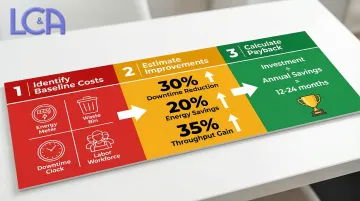
Calculate your ROI:
- Identify baseline costs – Energy consumption, waste/rework, downtime, labor hours
- Estimate improvements – Apply industry benchmarks (30% downtime reduction, 20% energy savings, 35% throughput gain)
- Calculate payback period – Divide total investment by annual savings
Industry data shows typical 12-24 month payback periods for PCS investments, with energy-focused projects often delivering even faster returns.
Industry Applications and Use Cases
Manufacturing and Discrete Production
In automotive, electronics, and consumer goods manufacturing, process control systems manage critical functions:
- Assembly line control and synchronization
- Real-time quality monitoring and defect detection
- Inventory management and material tracking
These systems maintain consistent quality while adapting production schedules to meet demand fluctuations.
Process Industries
Chemical Manufacturing: Batch control, continuous process optimization, and recipe management maintain product consistency while ensuring safety in hazardous environments.
Food & Beverage: Temperature control in food processing, pressure management in beverage production, and flow control in filling lines optimize throughput while maintaining food safety standards.
Lashley Cohen has implemented gas-fired oven controls that reduce process variability in baking operations, along with foam container production systems that manage bulk material handling and precise thickness control.
Pharmaceutical: Precise control with comprehensive documentation ensures batch consistency and regulatory compliance.
Oil & Gas: Well pad modernization using regenerative drives has recycled 95% of recovered energy, significantly lowering carbon footprint and operating costs.
Utilities and Infrastructure
Water/Wastewater Treatment: Load balancing, demand response, and energy optimization reduce operating costs while maintaining regulatory compliance.
Lashley Cohen designed a complete control system for a wastewater treatment facility featuring an innovative anaerobic process that saves hundreds of horsepower in aeration expenses.
Power Generation: DCS ensures precise control of complex combustion processes, maintaining grid stability and efficiency in response to fluctuating demand.
Building Automation: Remote monitoring and control of geographically dispersed assets optimize energy consumption across facilities.
Choosing and Implementing a Process Control System
Selection Criteria
Process Complexity:
- Continuous processes (chemical reactors, refineries) → DCS
- Discrete manufacturing (assembly, packaging) → PLC
- Hybrid processes (food & beverage, batch chemical) → Tiered architecture combining both
Scale Considerations:
- Single machine or small cell → PLC
- Department or process unit → PLC or small DCS
- Plant-wide → DCS with integrated PLCs
Industry Requirements:
- Regulatory compliance needs (FDA, EPA, OSHA)
- Safety certification levels (SIL 1-3)
- Documentation and audit trail requirements
Integration Needs:
- Existing systems and protocols
- Enterprise connectivity (ERP, MES)
- IIoT and analytics platforms
Budget Constraints:
- Initial capital investment
- Ongoing maintenance and support costs
- Training and commissioning expenses
Working with Experienced Integrators
Once you've identified the right system architecture, successful implementation depends on partnering with experienced integrators who bring:
- Deep understanding of control theory, process dynamics, and industry best practices for optimal architecture selection
- Established vendor relationships (such as Rockwell Bronze Partner status) providing access to technical support, training, and preferential pricing
- ISO-9001 certified project management ensuring systematic execution from requirements definition through commissioning
- Industry-specific knowledge across sectors like food & beverage, chemicals, and manufacturing to anticipate challenges and apply proven solutions
Implementation Best Practices
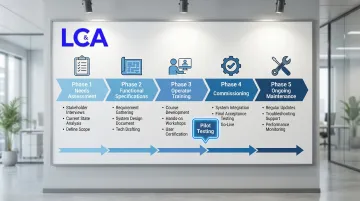
Follow these essential steps to ensure successful system deployment:
1. Conduct Thorough Needs Assessment
- Document current process performance and pain points
- Define specific, measurable objectives
- Identify constraints (budget, timeline, existing infrastructure)
2. Develop Detailed Functional Specifications
- Process and instrumentation diagrams (P&IDs)
- Control narratives describing desired behavior
- Safety requirements and interlocks
- HMI requirements and alarm philosophy
3. Plan for Operator Training
- Hands-on training with actual equipment
- Simulation environments for safe learning
- Documentation and standard operating procedures
4. Establish Commissioning Procedures
- Factory acceptance testing (FAT) before shipment
- Site acceptance testing (SAT) during installation
- Phased startup with pilot testing on non-critical loops
5. Implement Ongoing Maintenance Program
- Regular calibration schedules for instruments
- Backup procedures for programs and configurations
- Performance monitoring and optimization reviews
Start with pilot testing on non-critical areas to validate control strategies and ROI assumptions before full deployment. This phased approach reduces risk and allows for adjustments based on real-world performance.
Frequently Asked Questions
What are the 4 elements of process control?
The four elements are: 1) Process variable (parameter being controlled like temperature or pressure), 2) Sensor (monitors and transmits data), 3) Controller (compares measurement to setpoint and calculates correction), and 4) Actuator (implements correction via valves or motors).
What is the difference between PCS and DCS?
PCS (Process Control System) is the general term for all process control systems, while DCS (Distributed Control System) is a specific architecture where control functions are distributed across multiple controllers rather than centralized. DCS is commonly used in large continuous processes like refineries and chemical plants.
What are the three types of process control?
The three types are: 1) Feedback control (reacts to deviations after they occur), 2) Feedforward control (anticipates disturbances and adjusts proactively), and 3) Cascade control (uses multiple controllers in series, with the primary controller's output becoming the secondary's setpoint).
What are examples of process controls?
Common examples include: Temperature control in a chemical reactor (maintaining precise heat for consistent reactions), level control in a storage tank (preventing overflow or pump cavitation), pressure control in a steam system (ensuring safe operation and consistent delivery), pH control in wastewater treatment (neutralizing effluent before discharge), and flow control in a pipeline (maintaining consistent delivery rates despite pressure variations).
When should I use a DCS vs. a PLC?
Use a DCS for large continuous processes (refineries, chemical plants, power generation) with hundreds of control loops requiring native redundancy. Use a PLC for high-speed discrete control (packaging, assembly, material handling) where fast scan times matter most. Hybrid applications often benefit from combining both systems.
Conclusion
Process Control Systems have evolved from operational necessities to strategic assets that drive manufacturing profitability, safety, and sustainability.
Whether you're optimizing an existing facility or designing a new plant, the right PCS architecture, properly implemented and maintained, delivers measurable returns through reduced downtime, improved quality, energy savings, and enhanced safety.
Successful implementation requires partnering with experienced integrators who understand your industry's unique challenges. Lashley Cohen and Associates brings over 35 years of expertise across diverse industrial sectors:
- ISO-9001 certified project management processes
- Over 5,000 successful projects completed
- Certified PE Engineer on staff
- Rockwell Systems Bronze Partner
Ready to optimize your process control systems? Contact Lashley Cohen at (770) 962-0878 or websales@lashleycohen.com to discuss your specific requirements and explore how modern PCS can transform your operations.