Introduction
HMI/SCADA platforms monitor thousands of data points simultaneously across your facility. They serve as the nerve center of manufacturing operations, water treatment plants, and process industries worldwide, enabling real-time control that directly impacts productivity and profitability.
The challenge? Dozens of platforms claim superiority in functionality, scalability, and value. Choosing the right solution requires balancing technical capabilities with total cost of ownership.
According to MarketsandMarkets research, the global SCADA market will grow from $12.89 billion in 2025 to $20.05 billion by 2030. This reflects both the critical importance and rapid evolution of these systems.
This guide examines the top HMI/SCADA platforms based on proven performance, industry adoption, integration capabilities, and real-world implementation considerations to help you make an informed decision.
TL;DR
- HMI/SCADA platforms bridge operational technology (OT) and information technology (IT) for supervisory control and data acquisition
- Leading platforms—Ignition, Wonderware, Siemens WinCC, and Rockwell FactoryTalk—each excel in different use cases
- Web-based architectures and cloud integration now challenge traditional per-tag pricing models
- Focus on licensing model, protocol support, and alignment with your existing automation ecosystem
- Experienced systems integration matters as much as platform selection for implementation success
Overview of HMI/SCADA in Process Control Systems
HMI (Human-Machine Interface) provides visualization and operator control for specific machines or production lines, while SCADA (Supervisory Control and Data Acquisition) handles data acquisition, monitoring, and supervisory control across distributed systems and multiple sites.
These systems have evolved significantly from legacy monolithic architectures to modern distributed frameworks.
Modern platforms now feature:
- Web-based clients using HTML5 for zero-install access from any device
- Cloud connectivity enabling remote monitoring and control
- Integration with Manufacturing Execution Systems (MES) and Enterprise Resource Planning (ERP)
- Edge-to-cloud data processing for distributed operations
- Protocols like OPC UA and MQTT that enable Industrial IoT (IIoT) connectivity
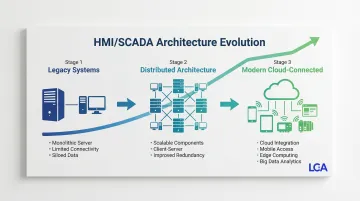
This architectural shift allows operators to access control systems anywhere, while supporting real-time data exchange across enterprise systems.
The SCADA market is growing robustly, driven by Industry 4.0 adoption, digital transformation initiatives, and the need for cyber-resilient operations platforms.
Multiple research firms project growth rates around 9% CAGR (Compound Annual Growth Rate) through 2030, with the Asia-Pacific region leading expansion at 10.2% CAGR due to rapid industrialization and smart infrastructure investments.
Top HMI SCADA Platforms for Process Control Systems
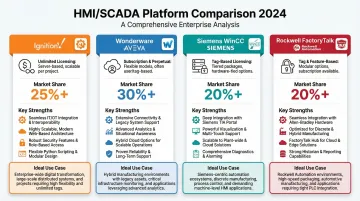
These four platforms represent the industry's most proven solutions, selected based on market presence, technical capabilities, ease of implementation, and breadth of industry applications.
Ignition by Inductive Automation
Founded in 2003 by systems integrator Steve Hechtman, Inductive Automation disrupted traditional SCADA licensing with Ignition's unlimited web-based platform and modular architecture. The company introduced a per-server licensing model that allows unlimited clients, tags, and connections—eliminating the expansion penalties that plague traditional platforms.
Key Differentiators:
Ignition's unlimited licensing model fundamentally changes SCADA economics. Organizations can add sensors, screens, and users without incurring additional software costs, potentially reducing total cost of ownership by 40-60% for larger installations compared to traditional tiered pricing.
The platform uses a server-centric web-deployment model where clients launch instantly from the server without individual workstation installation.
The Perspective module delivers mobile-responsive visualization built on HTML5 and CSS3, enabling interfaces to run natively in any web browser on phones, tablets, or desktops.
Native OPC UA support (acting as both client and server) and seamless SQL database integration bridge OT and IT without middleware.
Ideal Use Cases:
Ignition excels in manufacturing, food & beverage, and water/wastewater applications where scalability and cross-platform capability matter most. 57% of Fortune 100 companies use the platform, which holds approximately 12% of the global market share as the fastest-growing segment.
| Feature | Details |
|---|---|
| Licensing Model | Per-server unlimited licensing; typical pricing ranges from $7,500-$15,000 per server depending on modules; no per-tag or per-client fees |
| Key Technical Features | Native database integration with SQL; OPC-UA client and server; Perspective (web) and Vision (desktop) modules; Python scripting; MQTT Sparkplug support |
| Best For | Mid-to-large facilities seeking scalability; organizations with distributed sites; teams wanting rapid development and vendor-agnostic connectivity |
Wonderware (AVEVA System Platform)
Now part of Schneider Electric following AVEVA's full acquisition in January 2023, Wonderware brings decades of SCADA heritage and holds approximately 16% of the global market share. The platform offers a comprehensive industrial operations solution with deep vertical market capabilities and extensive third-party integrations.
Key Differentiators:
AVEVA System Platform's ArchestrA object-oriented framework enables template-based engineering that allows rapid deployment of changes across enterprise-wide operations, reducing engineering effort by up to 80% for multi-site facilities.
The Operations Management Interface (OMI) provides responsive visualization that auto-generates content across devices, modernizing the traditional InTouch HMI experience.
For regulated industries, the platform includes built-in 21 CFR Part 11 compliance features such as enforced audit trails, electronic signatures, and user security controls. It supports ALCOA+ data integrity principles (Attributable, Legible, Contemporaneous, Original, Accurate) essential for pharmaceutical and food & beverage GxP environments.
Ideal Use Cases:
Wonderware excels in oil & gas, pharmaceuticals, and utilities where compliance features, reliability, and extensive vendor support networks justify the investment. The mature ecosystem provides industry-specific templates and proven enterprise scalability.
| Feature | Details |
|---|---|
| Licensing Model | Traditional tag-based licensing with concurrent user options; evolving toward AVEVA Flex subscription model for OpEx budgeting |
| Key Technical Features | InTouch HMI visualization; Historian for time-series data; System Platform architecture; ArchestrA object-oriented framework; advanced alarm management |
| Best For | Enterprises requiring proven reliability; regulated industries needing 21 CFR Part 11 compliance; organizations with complex multi-site deployments |
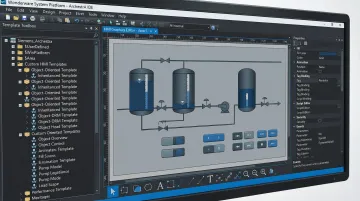
Siemens WinCC
Part of Siemens Digital Industries' integrated automation portfolio, WinCC offers comprehensive SCADA tightly integrated with Siemens automation hardware and the Totally Integrated Automation (TIA) Portal. The platform holds approximately 18% of the global market with particular dominance in automotive and discrete manufacturing.
Key Differentiators:
WinCC's primary advantage is seamless integration with Siemens PLCs and drives through TIA Portal's unified engineering environment.
Engineers can program SIMATIC S7 PLCs and WinCC HMIs in a single interface with shared tag databases, eliminating duplicate data entry and reducing engineering time by an estimated 30-40%.
The platform offers multiple editions: WinCC Unified (newest, utilizing native HTML5 and SVG for web-based visualization), WinCC Professional (for complex PC-based operation), and WinCC Runtime (operational execution software).
OpenPCS 7 extends capabilities for process industries requiring DCS-like functionality.
Ideal Use Cases:
WinCC excels in automotive, discrete manufacturing, and process industries where Siemens ecosystem integration, standardized engineering, and global support infrastructure provide significant value. Facilities standardized on Siemens automation hardware gain the most benefit.
| Feature | Details |
|---|---|
| Licensing Model | PowerTags-based licensing (external data point connections); sold in tiers (128, 512, 65,536 PowerTags); PowerPacks available for upgrades; internal calculated tags don't count toward limits |
| Key Technical Features | TIA Portal unified engineering; redundancy options; WinCC Unified web clients; native connectivity to SIMATIC controllers; OpenPCS 7 for process industries |
| Best For | Facilities standardized on Siemens automation; organizations seeking unified engineering environment; global manufacturers needing consistent platform across sites |
Rockwell Automation FactoryTalk
Rooted in Allen-Bradley heritage and part of Rockwell's Integrated Architecture philosophy, FactoryTalk holds approximately 14% of global market share with particular strength in North American discrete manufacturing. The comprehensive suite spans FactoryTalk View for HMI to FactoryTalk Historian and Analytics.
Key Differentiators:
FactoryTalk's deep integration with Allen-Bradley PLCs (ControlLogix, CompactLogix) and the broader Rockwell ecosystem provides significant advantages for facilities with existing Rockwell infrastructure. The platform offers strong MES connectivity and FactoryTalk View SE for distributed SCADA applications across enterprise environments.
PlantPAx represents Rockwell's modern DCS offering—not a separate product but a reference architecture leveraging FactoryTalk software and Logix hardware to deliver DCS capabilities. It includes pre-configured process objects and faceplates for process industries like oil & gas and chemicals, reducing engineering time while enforcing standardization.
Ideal Use Cases:
FactoryTalk excels in automotive, consumer goods, metals, and food & beverage industries where Allen-Bradley PLC infrastructure is already deployed. The integrated architecture philosophy delivers maximum value when implemented across the entire automation stack.
| Feature | Details |
|---|---|
| Licensing Model | Display-based licensing for View SE; server bundles include unlimited displays with set client counts (5, 10, 25); unlimited web clients (ViewPoint) in newer versions; Historian uses tiered tag-based model |
| Key Technical Features | FactoryTalk View SE (distributed SCADA) and ME (machine-level HMI); FactoryTalk Historian; integration with Studio 5000; alarm management; PlantPAx DCS architecture |
| Best For | Facilities with Allen-Bradley PLC infrastructure; manufacturers seeking integrated Rockwell ecosystem; organizations with existing FactoryTalk investments |
How We Chose the Best HMI SCADA Platforms
We evaluated these platforms using a comprehensive framework that assesses four critical dimensions: market presence (install base and industry recognition), technical capabilities (protocol support, scalability, and feature depth), implementation considerations (ease of deployment and learning curve), and total cost of ownership over a typical 10-year lifecycle.
Common selection mistakes include:
- Choosing based solely on upfront cost without considering long-term licensing, support, and upgrade expenses
- Selecting platforms incompatible with existing automation infrastructure, creating integration challenges
- Underestimating training requirements and internal technical capabilities needed for successful deployment
- Ignoring the importance of experienced systems integrators in implementation success
Avoiding these mistakes starts with recognizing that platform selection depends entirely on your specific context.
The "best" platform varies based on your existing automation ecosystem, industry regulatory needs (such as pharmaceutical 21 CFR Part 11 compliance), IT infrastructure preferences (on-premise versus cloud), internal technical capabilities, and budget constraints. A facility standardized on Allen-Bradley PLCs will realize far more value from FactoryTalk than from a vendor-agnostic platform, while a greenfield operation might benefit from Ignition's unlimited licensing model.
Given this complexity, working with experienced systems integrators helps ensure the right platform choice for your operation.
What systems integrators bring to platform selection:
- Objective assessments based on your operational goals rather than vendor relationships
- Architecture design that maximizes platform capabilities within your infrastructure
- Implementation expertise that reduces deployment time and risk
- Training programs tailored to your team's technical background
- Ongoing support that ensures your investment delivers expected ROI
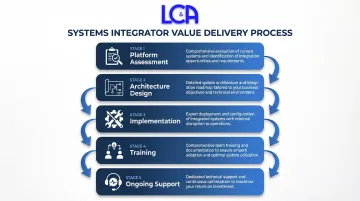
Lashley Cohen and Associates—ISO-9001 certified with 35+ years in controls integration—has guided manufacturers through platform selection and implementation across diverse industries, from food processing to metals manufacturing.
Conclusion
While Ignition, Wonderware, Siemens WinCC, and Rockwell FactoryTalk represent industry-leading solutions, the optimal choice depends on your facility's automation ecosystem, industry needs, and scalability requirements.
A Siemens-centric facility gains little from Ignition's vendor-agnostic flexibility, just as a mixed-vendor environment struggles with WinCC's ecosystem lock-in.
Successful HMI/SCADA implementation requires more than software selection—it demands:
- Experienced integration and architecture design
- Comprehensive operator training programs
- Ongoing support to maximize ROI
The difference between a platform that transforms operations and one that underdelivers often lies in implementation quality rather than software capabilities.
With over 35 years of experience and 5000+ completed projects, Lashley Cohen and Associates provides controls integration and engineering services to help organizations evaluate, implement, and optimize HMI/SCADA solutions across diverse industrial sectors. Contact us at (770) 962-0878 or websales@lashleycohen.com to discuss your process control system needs.
Frequently Asked Questions
Which SCADA system is best?
No single "best" system exists—Ignition excels for scalability and web-based architecture, Wonderware for enterprise reliability, Siemens WinCC for Siemens ecosystems, and Rockwell FactoryTalk for Allen-Bradley environments. Selection should align with your existing infrastructure and operational priorities.
Which HMI is best?
HMI is a component of SCADA systems rather than a standalone category. Leading solutions include Ignition Perspective (web-based), Wonderware InTouch (feature-rich displays), Siemens WinCC (TIA Portal integration), and Rockwell FactoryTalk View (Allen-Bradley). Best choice depends on deployment needs and existing automation platform.
Is SCADA a process control system?
SCADA is a supervisory control and data acquisition system that differs from DCS (Distributed Control System). SCADA handles supervisory-level control across distributed assets, while DCS provides continuous process control with tightly integrated controllers.
What is the difference between HMI and SCADA?
HMI focuses on local operator visualization and control for specific machines or production lines. SCADA encompasses broader supervisory control architecture monitoring processes across multiple sites, integrating hardware (PLCs, RTUs) and software for centralized data acquisition.
How much does HMI/SCADA software cost?
Ignition's per-server unlimited licensing ranges from $7,500-$15,000 with no per-tag fees. Traditional platforms like Wonderware, Siemens WinCC, and Rockwell FactoryTalk use tag-based models where costs scale with system size—potentially reaching $50,000-$200,000+ for enterprise implementations.
What industries use HMI/SCADA systems?
HMI/SCADA systems are deployed across manufacturing (automotive, consumer goods, food & beverage), process industries (oil & gas, chemicals, pharmaceuticals), utilities (water/wastewater, electric power), metals processing, and building materials. Each industry has specific compliance requirements and preferred platforms.