
Introduction
Manufacturing facilities struggle with unplanned downtime that costs Fortune Global 500 industrial organizations approximately $1.4 trillion annually—roughly 11% of total revenues. In automotive manufacturing alone, a single hour of downtime can cost $2.3 million.
The cascading consequences extend far beyond lost production: missed delivery deadlines trigger contractual penalties, emergency repairs drain maintenance budgets, and rushed restarts compromise quality. Equipment forced to restart repeatedly degrades faster, shortening asset lifespans and eroding competitive position.
Smart PLC (Programmable Logic Controller) logic prevents downtime before it occurs through predictive monitoring, automated fault detection, and intelligent decision-making. Modern PLC programming integrates sensors with systematic pre-start checks to identify potential failures early. These strategies shift control systems from reactive troubleshooting to proactive prevention, coordinating multi-machine operations that keep production lines running.
TLDR
- Unplanned downtime costs manufacturers billions in lost production and emergency repairs annually
- Smart PLC logic prevents failures through predictive monitoring and automated diagnostics
- Strategies include prevention, duration mitigation, and system-wide efficiency optimization
- Implementation reduces downtime events by 40-60% while extending equipment lifespan
How Downtime Costs Build Up in Manufacturing
Downtime costs accumulate in two distinct layers: immediate losses and hidden long-term expenses. Immediate losses are visible—halted production lines, idle labor waiting for repairs, and missed production quotas. A beverage line that should produce 1,600 containers per minute but sits idle for two hours loses 192,000 units of potential output.
Hidden costs prove more damaging over time:
- Deferred maintenance escalates into emergency repairs at triple the cost
- Quality suffers when operators rush equipment restarts without proper verification sequences
- Micro-stoppages—brief 1-5 minute interruptions—account for 20-30% of total downtime yet often escape tracking without automated systems
- One packaging company discovered micro-stoppages were costing 15% of potential productivity, reducing OEE from a theoretical 85% to actual 65%
These individual issues compound across your production environment. One unplanned stop triggers material starvation downstream and material overflow upstream, cascading delays across multiple shifts and production lines.
Key Downtime Drivers in Factory Operations
Downtime stems from three primary categories:
Equipment Failures (Mechanical/Electrical)
Aging equipment accounts for 44% of unplanned downtime incidents. Common failure modes include:
- Poor lubrication practices causing 40% of equipment failures
- Bearing failures from inadequate monitoring
- Motor overheating due to electrical issues
- Hydraulic system leaks compromising performance
Process Issues
Material flow disruptions and quality defects halt production without mechanical failure:
- Upstream material starvation triggering emergency stops
- Downstream buffer overflow forcing line shutdowns
- Process parameter drift reducing output quality
- Defects requiring rework or scrapping
Operational Factors
Human factors contribute 23% of unplanned downtime:
- Manual changeovers between products extending idle time
- Missing spare parts accounting for 50% of Mean Time To Repair
- Operator errors during startup sequences
- Inadequate safety interlocks failing to protect equipment
Downtime drivers vary by industry—continuous process manufacturing faces different challenges than discrete batch manufacturing.
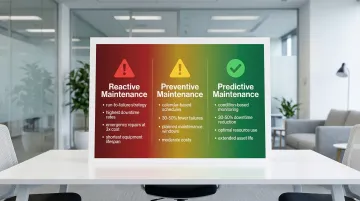
The maintenance approach determines impact severity. Facilities relying on reactive "run-to-failure" strategies experience significantly higher downtime than those implementing preventive and predictive maintenance, which demonstrate 30-50% fewer machine failures.
10 Proven Strategies to Reduce Factory Downtime Using Smart PLC Logic
The following strategies leverage PLC programming, sensor integration, and intelligent automation to address downtime at three levels: prevention (stopping failures before they occur), mitigation (minimizing duration when failures happen), and system optimization (improving plant-wide efficiency).
Strategies That Use PLC Logic to Prevent Downtime Before It Happens
Strategy 1: Implement Predictive Condition Monitoring Through PLC-Integrated Sensors
Modern PLCs continuously monitor equipment health parameters—vibration, temperature, pressure, current draw—and trigger alerts or automated shutdowns before catastrophic failure occurs.
Unlike traditional sensors that only trip at fixed limits, smart sensors detect degrading performance patterns days or weeks before failure.
Sensor Types and Integration:
- Vibration sensors detect abnormal oscillations in motors, signaling bearing failure before seizure occurs
- Smart temperature sensors warn of overheating trends using adaptive thresholds rather than fixed limits
- Current monitoring identifies motor overload conditions indicating mechanical binding or process issues
- Pressure transmitters track hydraulic and pneumatic system degradation
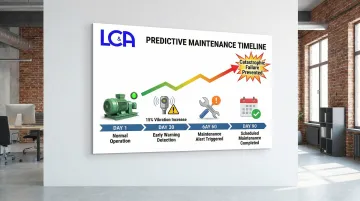
Lead Time and Impact: Predictive maintenance systems identify warning signs up to 90 days before functional failure, allowing scheduled maintenance during planned downtime windows.
One oil and gas facility suffered a $3 million bearing failure that post-incident analysis revealed could have been prevented—the cooling system had operated incorrectly for six months, a condition PLC-based monitoring would have flagged immediately.
Threshold-based logic and trend analysis in PLC programming convert sensor data into actionable intelligence. If vibration exceeds baseline by 15% over three consecutive readings, the PLC logs an alert. If temperature rises 2°F per hour for four hours, the system triggers maintenance notification before reaching critical limits.
Strategy 2: Program Automated Pre-Start Equipment Checks and Interlocks
Improper startup sequences damage equipment and cause unplanned stops.
PLC logic executes systematic pre-start verification sequences—checking that guards are closed, pressures are correct, temperatures are stable, and lubrication systems are primed—before permitting equipment startup.
Pre-Start Check Logic:
- Verify all safety guards are closed and locked
- Confirm hydraulic pressure reaches minimum threshold
- Check lubrication system pressure indicates proper flow
- Validate temperature sensors read within acceptable startup range
- Ensure upstream and downstream equipment is ready to receive/supply material
Safety Interlock Standards: Safety interlocks prevent operators from starting equipment under unsafe or non-optimal conditions. PLC logic must adhere to ISO 13849 and IEC 62061 functional safety standards.
Certain critical trips—such as loss of purge pressure in hazardous areas—require hardwired interlocks in addition to PLC monitoring to meet safety directives like ATEX.
Digital Standard Operating Procedures enforce operator verification via HMI confirmation or photo verification before the line starts, preventing the startup failures that cause 15-20% of unplanned downtime events.
Strategy 3: Deploy Smart Lubrication and Preventive Maintenance Triggers
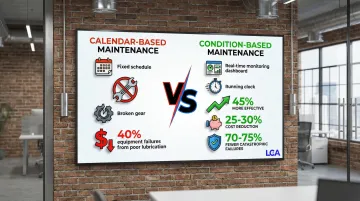
Calendar-based maintenance schedules waste resources—servicing equipment that doesn't need it while missing equipment that does.
PLCs track actual runtime hours, cycle counts, and operating conditions to trigger maintenance tasks based on real usage rather than arbitrary schedules.
Condition-Based Lubrication: Automated lubrication systems controlled by PLC logic deliver precise amounts of lubricant at optimal intervals based on actual machine operation.
The PLC monitors:
- Actual runtime hours (not calendar days)
- Number of operational cycles
- Load conditions (heavy load requires more frequent lubrication)
- Temperature (higher temperatures accelerate lubricant breakdown)
Systems like the G-LUBE EM D integrate directly with PLCs, receiving trigger signals and sending feedback status.
This prevents both under-lubrication (leading to wear and the 40% of equipment failures attributed to poor lubrication) and over-lubrication (causing contamination and seal damage).
Maintenance Cost Reduction: Condition-based maintenance proves 45% more effective than time-based maintenance for multi-component systems. Implementing predictive strategies including smart lubrication reduces total maintenance costs by 25-30% and eliminates 70-75% of catastrophic breakdowns.
Strategy 4: Use PLC Logic for Intelligent Material Flow and Buffer Management
Material starvation halts production as effectively as equipment failure.
PLCs manage upstream and downstream buffer zones to prevent conditions that stop production lines, using sensor feedback to adjust feed rates dynamically.
Buffer Management Algorithms:
- Monitor buffer fill levels continuously via sensors
- Adjust upstream feed rates when downstream consumption slows
- Prevent overflow conditions that trigger emergency stops
- Coordinate start/stop sequences across multiple production stages
Predictive Flow Control: Advanced PLC algorithms analyze downstream consumption patterns and adjust upstream feed rates proactively.
If downstream equipment cycles slow by 10%, the PLC reduces upstream feed rate proportionally before buffers overflow. As downstream equipment recovers, feed rates increase to restore optimal buffer levels.
Coordinated logic prevents cascade failures where one machine fault propagates upstream (causing blockages) and downstream (causing starvation). Proactive maintenance and flow strategies implementing these principles achieve 30-50% reduction in downtime.
Strategies That Use PLC Logic to Minimize Downtime Duration
Prevention strategies stop many failures before they occur. But when equipment does fault, minimizing diagnostic time becomes critical.
Strategy 5: Enable Rapid Fault Diagnosis with Detailed PLC Alarm Systems
Well-structured PLC alarm and event logging systems provide maintenance teams with specific fault codes, timestamps, and equipment states at failure, dramatically reducing diagnostic time.
Poor alarm management contributes to over $20 billion in lost production annually.
ISA-18.2 Alarm Management Standards: The ANSI/ISA-18.2-2016 standard defines best practices for alarm management in process industries. Regulatory bodies including OSHA recognize it as good engineering practice.
Key principles include:
- Alarm prioritization: Approximately 5% High priority, 15% Medium, 80% Low
- Alarm rationalization: Each alarm must have documented purpose and operator response
- Alarm flood prevention: Maximum 10 alarms per 10-minute period during upset conditions
- Actionable guidance: Alarm messages provide specific corrective actions, not just fault notifications
Case Study Results: A chemical plant implementing ISA-18.2 standards reduced alarm load by 84%, cutting standing alarms from pages of text to 10-12 active items.
This clarity allowed operators to identify and resolve utility upsets before they caused production delays, reducing diagnostic time from 45 minutes to under 10 minutes per event.
Effective PLC alarm logic includes:
- Timestamp recording at millisecond resolution
- Equipment state capture (speeds, temperatures, pressures) at moment of fault
- Sequence of events logging showing which fault occurred first
- Automated notification to maintenance personnel with specific fault location
Strategy 6: Implement Automated Changeover Sequences and Recipe Management
Manual changeovers between products consume hours and introduce human error. PLC-based recipe management systems store optimal parameters for different products and execute automated changeovers, reducing setup time and eliminating variability.
Recipe Management Systems: PLCs store hundreds or thousands of product recipes containing:
- Operating speeds and feed rates
- Temperature and pressure setpoints
- Quality inspection parameters
- Material specifications and sources
Once operators select a new recipe via HMI, the PLC automatically adjusts all parameters, verifies settings, and guides operators through manual steps requiring physical adjustments.
Changeover Time Reduction:
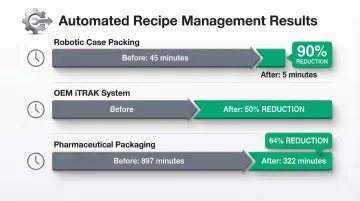
- A robotic case packing solution reduced changeover from 45 minutes to 5 minutes (90% reduction), achieving uptime greater than 99%
- An OEM using Rockwell iTRAK reduced format changeovers by 50%, significantly boosting OEE
- A pharmaceutical packaging line cut changeover time by 64% (from 897 to 322 minutes), increasing OEE from 18% to 26%
Sequential Function Chart Programming: SFC (Sequential Function Chart) programming per IEC 61131-3 standard defines specific states, transitions, and actions for automated changeovers. Each step verifies completion before advancing, ensuring consistency and preventing the errors that occur when operators skip steps or perform them out of sequence.
Strategy 7: Program Graceful Degradation and Bypass Modes
Sophisticated PLC logic allows equipment to continue operating in reduced-capacity mode when non-critical components fail, rather than forcing complete shutdown. This "limp mode" maintains partial production while repairs are scheduled.
Graceful Degradation Examples:
- A packaging line with three filling heads continues at 66% capacity when one head fails
- A conveyor system bypasses a failed section using alternate routing
- A multi-zone oven maintains production when one zone's heater fails by adjusting remaining zones
Implementation Requirements: Graceful degradation logic requires:
- Fault isolation: PLC identifies which specific component failed
- Capability assessment: Logic determines remaining system capacity
- Automatic reconfiguration: System adjusts parameters for reduced-capacity operation
- Safety verification: Ensures degraded operation meets safety requirements
- Operator notification: HMI clearly indicates degraded mode and limitations
Safety Considerations: Bypass logic must maintain safety integrity. Redundancy architectures like Hot Standby (seamless switchover) and Warm Standby (manual or delayed switchover) ensure control continuity. Advanced heterogeneous PLC-based distributed controllers achieve 98% fault coverage with switchover latencies as low as 41 milliseconds, eliminating production downtime in specific failure scenarios.
Strategies That Use PLC Logic to Optimize the Broader Production System
Beyond addressing individual equipment, plant-wide optimization requires system-level visibility and coordination.
Strategy 8: Integrate PLCs with SCADA/MES Systems for Real-Time Visibility
Connecting PLCs to supervisory control and data acquisition (SCADA) or manufacturing execution systems (MES) provides plant-wide visibility into equipment status, enabling faster response to developing issues and coordinated resource allocation.
Integration Benefits:
- Centralized monitoring: Operations managers view all production lines from single dashboard
- Faster response: Developing issues trigger alerts before causing downtime
- Resource coordination: Maintenance teams prioritize response based on production impact
- Informed scheduling: Production planning accounts for real-time equipment status
Communication Protocols: OPC UA (Open Platform Communications Unified Architecture) provides secure, platform-agnostic communication between PLCs (including legacy machines) and MES/SCADA layers. OPC UA enables multi-vendor integration, allowing Siemens, ABB, and Rockwell PLCs to communicate on unified platforms.
Documented Results:
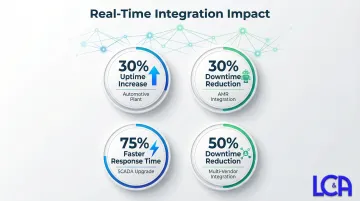
- An automotive plant increased uptime by 30% by integrating MES, SCADA, PLC, and IIoT systems
- Integrating Autonomous Mobile Robots with PLCs and SCADA reduced downtime by 30% through proactive maintenance and real-time operational insights
- A smart SCADA upgrade reduced response time to outages by 75% and cut preventable downtime by 40%
- Multi-vendor PLC integration onto single platforms using OPC UA reduced downtime by 50%
Lashley Cohen and Associates' controls integration expertise enables this type of real-time data exchange and centralized control, leveraging their Rockwell Systems Bronze Partnership and 35+ years of experience to implement seamless communication across diverse industrial equipment.
Strategy 9: Deploy Coordinated Multi-Machine Logic to Prevent Cascade Failures
Networked PLCs communicate equipment status across production lines, allowing upstream machines to adjust when downstream issues are detected, preventing material waste, secondary jams, and cascade failures.
Coordination Logic:
- Status broadcasting: Each PLC publishes equipment state (running, stopped, faulted, starved) to network
- Conditional control: Upstream equipment monitors downstream status before feeding material
- Coordinated shutdown: When downstream equipment faults, upstream equipment executes controlled stop rather than emergency stop
- Sequenced restart: Equipment restarts in proper order to prevent power surges and mechanical shocks
Preventing Cascade Failures: Without coordination, a fault in one machine propagates upstream (causing blockages) and downstream (causing starvation). A jammed conveyor causes upstream equipment to continue feeding material, creating secondary jams and material damage. Coordinated logic detects the jam and stops upstream feed immediately.
Industrial Ethernet Protocols: Real-time coordination requires high-speed communication protocols:
- EtherNet/IP: Rockwell Automation's industrial protocol enabling millisecond-level coordination
- PROFINET: Siemens protocol for deterministic real-time control
- OPC UA: Cross-platform protocol ensuring fault signals from any PLC brand are instantly understood by other controllers
State machine logic implemented in ladder programming allows sequential control where faults trigger specific, contained stop/reset sequences rather than chaotic line-wide halts.
Strategy 10: Use Historical PLC Data for Continuous Improvement and Root Cause Analysis
Data historians collecting PLC tag values over time enable engineers to perform detailed root cause analysis of downtime events, identifying patterns invisible in real-time monitoring.
Historian Capabilities: Modern historians (FactoryTalk Historian SE, WinCC Historian) aggregate PLC data hierarchically:
- Tag-level data (individual sensor readings)
- Equipment-level data (machine performance metrics)
- Line-level data (production throughput and quality)
- Plant-level data (overall facility performance)
Root Cause Analysis: After downtime occurs, engineers query historical data to identify contributing factors:
- Did temperature gradually increase before failure?
- Did vibration levels trend upward over weeks?
- Did cycle times gradually lengthen indicating wear?
- Did similar failures occur at consistent intervals?
Continuous Improvement Results:
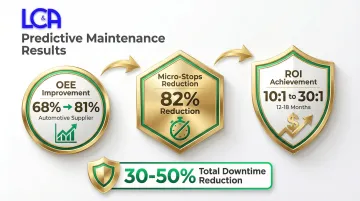
- A Tier-1 automotive supplier improved OEE from 68% to 81% and reduced micro-stops by 82% using AI models analyzing PLC sensor data to auto-adjust feed rates
- Facilities using AI-driven predictive maintenance based on historical data see 30-50% reduction in total machine downtime
- Organizations implementing predictive maintenance achieve 10:1 to 30:1 ROI ratios within 12-18 months
Trending PLC data reveals gradual degradation addressable proactively. When cycle times increase 5% over three months, scheduled maintenance prevents the eventual failure that would cause emergency downtime.
Conclusion
Reducing factory downtime through smart PLC logic requires strategic approaches that address prevention, rapid response, and continuous optimization. Successful implementation demands technical expertise in PLC programming and commitment to data-driven decision-making.
The 10 strategies outlined transform PLCs from simple equipment controllers into intelligent reliability systems that predict failures, prevent cascade events, minimize diagnostic time, and continuously improve performance.
Manufacturers implementing these approaches achieve measurable results:
- 30-50% downtime reduction
- 25-30% maintenance cost savings
- OEE improvements of 10-15 percentage points
Partnering with experienced controls integrators accelerates results and reduces implementation risks. Lashley Cohen and Associates has helped manufacturers across diverse industries implement these smart PLC strategies since 1988, combining ISO-9001 certified processes with deep Rockwell systems expertise to deliver sustainable downtime reduction.
Frequently Asked Questions
How can I reduce factory downtime?
Implement PLC-based predictive maintenance systems, automated fault detection with alarm management, and systematic root cause analysis using historical data. Technology alone isn't sufficient—success requires a maintenance culture emphasizing proactive intervention over reactive fixes.
What are the 4 P's of maintenance?
The 4 P's are: Prevention (scheduled tasks avoiding failures), Prediction (condition monitoring forecasting issues), Proactive (addressing root causes), and Planned (efficient resource scheduling). PLC systems enable the first three through continuous data collection and pattern recognition.
What is the role of PLC logic in preventing downtime?
PLCs continuously monitor conditions, detect anomalies, and trigger responses faster than human operators. Their 24/7 vigilance identifies developing problems weeks before failure, executes pre-start safety checks, and coordinates multi-machine operations to prevent cascade failures.
How much does unplanned downtime typically cost manufacturers?
Costs range from thousands to hundreds of thousands per hour. Automotive manufacturers lose $2.3 million per hour, pharmaceuticals $100,000-$500,000, and FMCG $36,000-$39,000. Beyond lost production, indirect costs include overtime labor, rush shipping, and emergency repairs.
What is the difference between planned and unplanned downtime?
Planned downtime is scheduled for maintenance during low-demand periods with parts and personnel ready. Unplanned downtime occurs unexpectedly, causing emergency response and schedule disruptions. Smart PLC systems convert unplanned events into planned opportunities through predictive monitoring.
Can PLC programming reduce maintenance costs as well as downtime?
Yes, intelligent PLC logic enables condition-based maintenance (servicing only when needed), prevents catastrophic failures, and extends equipment life. Research shows predictive systems reduce maintenance costs by 18-25% compared to preventive methods and downtime by 30-50%.