Introduction
When a PLC fails, production stops. These computer-based control systems manage everything from production line sequencing to process variable monitoring across manufacturing, food & beverage, water treatment, and other industrial sectors.
The cost of neglecting PLC maintenance is substantial. Unscheduled production stoppages cost manufacturers an average of $260,000 per hour in lost production, emergency repairs, and potential safety incidents. For automotive manufacturers, this figure skyrockets to $2.3 million per hour, while even food & beverage facilities face costs around $100,000 per hour.
This guide provides a preventive maintenance framework to help you avoid these costly failures, including essential checklist items organized by frequency and practical guidelines for implementation.
TLDR
- Preventive maintenance cuts unplanned downtime by 30-50% and eliminates stoppages costing hundreds of thousands per hour
- Tiered schedules require just 15 minutes weekly, 2-3 hours quarterly, and 4-8 hours annually
- Battery replacement (every 3-5 years), quarterly backups, and environmental monitoring prevent 70% of failures
- Proper maintenance extends PLC lifespan from 10-15 years to 20+ years
- Engage professional services for complex issues, system migrations, or when obsolescence threatens production continuity
Why PLC Maintenance Prevents Production Stoppages
Regular PLC maintenance directly impacts production continuity and your facility's bottom line. Understanding these connections helps justify maintenance investments and prioritize critical tasks.
Impact on Production Uptime and Reliability
PLCs control critical production processes. A single controller failure can halt entire production lines or facility operations.
The ripple effects extend beyond stopped production—they include potential damage to connected equipment, quality issues in products already in process, and serious safety risks.
Research demonstrates that preventive PLC maintenance reduces unplanned downtime by 30-50% compared to reactive maintenance approaches.
The U.S. Department of Energy reports that predictive maintenance strategies can decrease equipment breakdowns by 70-75%, representing a dramatic improvement in reliability.
The average large manufacturing plant experiences 25 downtime incidents per month, down from 42 in 2019, largely due to improved maintenance technologies and practices. However, recovery time has increased to 81 minutes per incident, up from 49 minutes five years ago, primarily due to skills shortages and supply chain complexity.
Financial Impact of Unscheduled Stoppages
These reliability improvements translate directly into financial performance. The financial case for preventive maintenance is compelling when compared to emergency response costs:
Industry-Specific Downtime Costs:
- Automotive manufacturing: $2.3 million per hour (doubled since 2019)
- General manufacturing: $260,000 per hour average
- Food & beverage: $100,000 per hour
- FMCG (Fast Moving Consumer Goods): $36,000 per hour
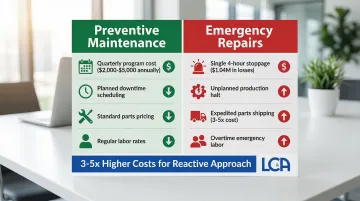
The ROI calculation is straightforward: a quarterly maintenance program costing $2,000-5,000 annually versus a single 4-hour emergency stoppage at $260,000/hour equals $1.04 million in potential losses. Emergency repairs typically cost 3 to 5 times more than planned maintenance due to overtime labor, expedited parts shipping, and lost production.
Indirect costs compound these figures:
- Rush shipping for replacement parts at premium prices
- Overtime labor for emergency troubleshooting
- Lost customer confidence and damaged relationships
- Potential contract penalties for missed deliveries
- Secondary equipment damage from cascading failures
Safety and Compliance Considerations
Malfunctioning PLCs create serious safety hazards in facilities with automated equipment, conveyors, or process control systems. Regulatory compliance now mandates documented maintenance programs across multiple industries.
Key regulatory requirements:
- OSHA (29 CFR 1910.119): Process Safety Management requires mechanical integrity programs specifically including PLCs, monitoring devices, sensors, alarms, and interlocks
- NFPA 70B: Transitioned from recommended practice to mandatory standard in 2023, requiring documented Electrical Maintenance Programs (EMP) for industrial equipment
- FDA (21 CFR Part 117): Food & beverage facilities must establish written procedures for production and process control, including system maintenance and validation
Proper maintenance documentation protects against liability in the event of incidents and demonstrates due diligence during regulatory inspections.
Asset Lifespan Extension
Preventive maintenance extends PLC operational life from the typical 10-15 years to 20+ years for well-maintained legacy systems. Manufacturer data indicates a useful life of 20 years for safety control system components before replacement becomes mandatory, but only with proper maintenance.
Predictive maintenance strategies extend machinery life by 20-40%, delivering substantial value by delaying costly full system replacements. For facilities with established Rockwell/Allen-Bradley or other platforms, maintaining existing systems avoids the significant costs and risks of system migration while preserving valuable institutional knowledge.
Types of PLC Maintenance
Effective PLC maintenance requires multiple approaches working together, not a one-size-fits-all strategy. Understanding each type helps you allocate resources appropriately.
Routine Preventive Maintenance
Scheduled, time-based maintenance performed regardless of equipment condition forms the foundation of any maintenance program.
Typical tasks include:
- Visual inspections of cabinets and components
- LED indicator status verification
- Connection tightness checks
- Environmental monitoring (temperature, humidity, dust levels)
- Filter cleaning and replacement
This approach works well for stable environments with well-documented systems operating within normal parameters.
Standard PLC systems typically cost $500-$2,000 per quarterly service, primarily covering labor for in-house technicians or contracted services.
Preventive maintenance is 12-18% less expensive than reactive maintenance, with every $1 invested typically saving $3-$5 in future reactive costs.
Corrective/Reactive Maintenance
Unplanned maintenance triggered by equipment failure or malfunction carries the highest costs and greatest risks.
Risks of over-reliance:
- 3-5x higher costs than preventive maintenance
- Unpredictable downtime disrupting production schedules
- Potential for secondary damage to connected systems
- Emergency parts procurement at premium prices
- Extended recovery times due to diagnostic complexity
These financial impacts add up quickly. Each incident costs $5,000-$25,000+, including emergency service calls, expedited parts shipping, overtime labor, and production losses.
While unavoidable for major failures, unexpected environmental events, or component defects, this approach should represent the smallest portion of your maintenance strategy.
Predictive/Condition-Based Maintenance
Data-driven maintenance based on monitoring actual equipment condition represents the most advanced approach, though it requires initial investment.
Monitoring approaches:
- PLC diagnostic software tracking scan times and error logs
- Thermal imaging for hot spots on components and terminals
- Power quality monitoring for voltage fluctuations
- I/O module performance trending
- Communication network health monitoring
Advantages:
- Maintenance performed only when needed based on actual condition
- Maximum equipment utilization without unnecessary interventions
- Early warning of developing problems before failures occur
- 30-40% reduction in overall maintenance spending
Expect to invest $10,000-$50,000 for monitoring systems and software, plus $2,000-$5,000 annually for subscriptions and support.
The ROI justifies the investment. Payback periods average 12-36 months, with critical assets often achieving ROI in under 18 months and 10x ROI within 2-3 years.
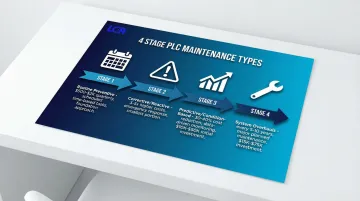
Comprehensive System Overhauls
Major planned maintenance involving deep servicing, component replacement, and system upgrades typically performed every 5-10 years ensures long-term system viability.
What's involved:
- Complete program backup and documentation
- Systematic replacement of aging components (power supplies, I/O modules, batteries)
- Cabinet cleaning and rewiring
- Firmware and software updates
- Comprehensive testing and validation
This approach is required for aging systems approaching end-of-life, planned facility upgrades, changing production requirements, or obsolescence concerns.
Budget $15,000-$75,000 depending on system complexity, including parts, engineering services, and planned downtime coordination. These overhauls benefit from experienced controls integration specialists who can assess system condition, recommend strategic upgrades, and coordinate minimal production disruption.
Essential PLC Maintenance Checklist
Unplanned downtime costs manufacturers an average of $260,000 per hour. This frequency-based checklist helps you catch problems early, before they trigger production stoppages.
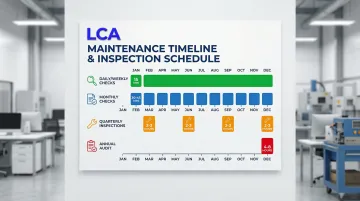
| Frequency | Duration | Key Focus Areas |
|---|---|---|
| Daily/Weekly | 15 min | Visual checks, LED status, environmental scan |
| Monthly | 30-45 min | Fault logs, backups, communication testing |
| Quarterly | 2-3 hours | Connections, modules, filters, thermal imaging |
| Annual | 4-8 hours | Complete backup, battery replacement, documentation |
Daily/Weekly Quick Checks (15-Minute Scan)
Visual cabinet inspection:
- Check for obvious damage, loose components, or physical deterioration
- Look for unusual odors indicating burnt electronics
- Verify no moisture, condensation, or liquid intrusion
LED indicator verification:
- Confirm all status LEDs show normal operation (power, run mode, communication, I/O status)
- Document any fault or warning indicators for follow-up
- Check battery status LED monthly as early warning of degradation
Environmental quick check:
- Verify adequate ventilation and airflow
- Check cabinet temperature stays well below the manufacturer's maximum rating
- Ensure no obstructions blocking air intake or exhaust
Listen for unusual sounds:
- Fans running continuously at high speed (indicates cooling issues)
- Relay chattering or excessive cycling
- Abnormal noises from connected equipment
These quick daily scans take minimal time but catch developing problems early. Step up to monthly checks for deeper system monitoring.
Monthly Checks (30-45 Minutes)
Review PLC fault logs through your programming software to examine error history. Identify recurring issues and track fault patterns that signal developing problems.
Verify backup power systems:
- Confirm UPS functions properly with adequate battery capacity for controlled shutdowns
- Test automatic transfer to backup power during simulated outages
Check physical security - ensure cabinet doors close and lock properly, with no signs of unauthorized access or environmental seal damage.
Test communication links:
- Verify PLC communicates with HMI without errors
- Check SCADA system connections and response times
- Test networked I/O for timeouts or dropped connections
Monthly monitoring reveals software and communication issues. Quarterly inspections focus on physical hardware integrity.
Quarterly Deep Inspections (2-3 Hours)
Connection integrity:
- Check and tighten all terminal connections
- Inspect wiring for signs of wear, fraying, or damage
- Verify proper cable routing and strain relief
- Look for burn marks or discoloration on terminals
Module seating verification:
- Ensure all I/O modules properly seated in backplane
- Check communication cards for secure connections
- Inspect connector pins for corrosion or damage
Cabinet filter service:
- Clean or replace air filters (critical in dusty environments)
- Inspect filter housing for proper seal
- Document filter condition and replacement dates
Power supply verification:
- Measure and document input voltage levels
- Check output voltages from PLC power supplies
- Verify readings within specification (typically ±5% tolerance)
Thermal inspection:
- Use thermal imaging camera to identify hot spots
- Check components, terminals, and wiring for temperature anomalies
- Document baseline temperatures for trending
Quarterly inspections catch physical deterioration. Annual audits ensure long-term system reliability and disaster preparedness.
Annual Comprehensive Audits (4-8 Hours)
Complete program backup:
- Create full backup of PLC program and configuration
- Backup HMI screens and SCADA configurations
- Store multiple copies in secure locations (on-site and off-site)
- Verify backup integrity by testing restoration
Battery replacement:
- Replace backup batteries in CPU modules (typically 3-5 year lifespan)
- Many manufacturers recommend annual replacement in critical applications
- Battery life degrades significantly with heat—batteries rated for 3 years at 36-40°C may last only 8 months at 56-70°C
Terminal torque verification:
- Use calibrated torque screwdriver to verify all connections
- Follow manufacturer's torque specifications
- Prevents high-resistance connections that cause failures
Comprehensive fault log analysis:
- Review entire year's fault logs
- Identify patterns and recurring issues
- Prioritize corrective actions based on frequency and severity
Spare parts inventory audit:
- Verify sufficient stock of critical components (I/O modules, power supplies, communication cards)
- Update inventory based on system changes
- Address component obsolescence proactively
Documentation update:
- Ensure all program changes properly documented
- Update wiring diagrams and schematics
- Verify manuals reflect current system configuration
For facilities requiring comprehensive maintenance support, Lashley, Cohen and Associates provides professional PLC troubleshooting and diagnostics services backed by over 35 years of industrial automation experience. Our field service team handles everything from routine inspections to emergency diagnostics across diverse manufacturing sectors.
PLC Maintenance Schedule by Frequency
Maintenance frequency varies based on operating environment, system criticality, and equipment age. Use these guidelines to establish appropriate intervals for your facility.
Maintenance Frequency Reference Table
| Task Category | Low-Criticality/Clean Environment | High-Criticality/Harsh Environment | Typical Duration |
|---|---|---|---|
| Visual inspection, LED check | Weekly | Daily/Per-Shift | 5-10 minutes |
| Environmental check, listen for unusual sounds | Weekly | Daily | 15 minutes |
| Fault log review, communication verification | Monthly | Weekly | 30-45 minutes |
| Connection checks, filter service, power verification | Quarterly | Monthly | 2-3 hours |
| Program backup, battery replacement, full audit | Annual | Quarterly | 4-8 hours |
Usage and Environmental Considerations
These base intervals adjust based on your operational demands and facility conditions.
Continuous operation (24/7 facilities):
- Increase inspection frequency by 50%
- Plan maintenance during scheduled production breaks
- Stock critical spares for power supplies, I/O modules, and communication cards
Harsh environments (high dust, extreme temperatures, high humidity, corrosive atmospheres):
- Double the frequency of filter changes
- Monitor cabinet temperatures and humidity levels weekly instead of monthly
- Shorten battery replacement intervals to 12-16 months in high-temperature environments (>40°C)
Critical systems with no redundancy:
- Implement predictive monitoring with weekly fault log reviews
- Stock backup controllers, I/O modules, and communication cards
- Pre-qualify emergency service providers with response-time agreements
Seasonal Adjustments
Summer months:
- Increase HVAC and temperature monitoring in facilities without climate control
- Check cooling systems functioning properly
- Check for heat-related component stress
Humid seasons:
- Monitor for moisture and condensation issues
- Inspect for corrosion on terminals and connectors
- Verify environmental seals on cabinets
Planned shutdown periods:
- Schedule major maintenance during holidays or traditional plant closures
- Coordinate comprehensive audits with production schedules
- Minimize impact on operational uptime
When to Call Professional PLC Services
While many maintenance tasks can be handled by in-house maintenance teams, certain situations require specialized expertise from controls integration professionals.
Complex System Issues Requiring Engineering Support
Recurring problems that in-house troubleshooting cannot resolve:
- Intermittent faults without clear patterns
- Communication issues across multiple systems
- Performance degradation without identifiable cause
- Integration challenges between legacy and modern systems
System upgrades or expansions:
- Adding new equipment to existing PLC systems
- Integrating legacy PLCs with modern SCADA/MES systems
- Migrating programs from obsolete platforms
- Optimizing production line throughput
Controls integration firms with experience across food & beverage, water treatment, and manufacturing environments can resolve technical challenges that exceed in-house capabilities. Lashley Cohen & Associates has completed 5000+ projects since 1988 with ISO-9001 certified processes.
Planned System Overhauls and Modernization
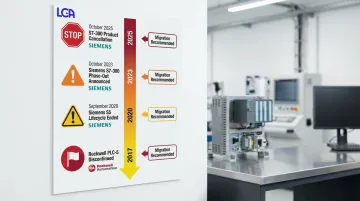
Many PLCs from the 1990s-early 2000s are reaching manufacturer end-of-support dates:
- Rockwell PLC-5: Discontinued in 2017, manufacturers recommend migrating to ControlLogix
- Siemens SIMATIC S5: Product lifecycle ended September 30, 2020
- Siemens S7-300: Phase-out announced October 1, 2023; product cancellation set for October 1, 2025
- GE Fanuc 90-30: Obsolete with limited spare parts availability
Professional project management offers several advantages:
- Minimized downtime through careful planning and phased implementation
- Proper testing and validation before production restart
- Comprehensive documentation for future maintenance
- Training for maintenance staff on new systems
Firms with Rockwell Systems Partner status and certified PE Engineers can handle migrations with minimal disruption while ensuring regulatory compliance.
Emergency Response and Critical Failures
Call for emergency support when facing:
- Complete system failures during production
- Safety system malfunctions requiring immediate attention
- Fires or physical damage to PLC equipment
- Suspected cybersecurity incidents affecting control systems
Pre-established relationships with controls integration firms provide:
- Faster response times with pre-negotiated service agreements
- Familiarity with your specific systems and configurations
- Access to specialized diagnostic equipment
- Spare parts inventory for common components
Establish relationships before emergencies occur to ensure rapid response. Consider scheduling a system assessment to identify potential risks and develop a contingency plan.
Frequently Asked Questions
What is PLC maintenance?
PLC maintenance includes routine inspections, preventive servicing, and corrective actions to ensure programmable logic controllers operate reliably. Core tasks include visual checks, environmental monitoring, connection verification, program backups, and scheduled component replacement.
What are the basic preventive maintenance elements and rules for PLC maintenance?
The five pillars include regular inspections, environmental control (temperature, dust, humidity), connection integrity verification, program backups in multiple locations, and scheduled component replacement (batteries every 3-5 years, filters quarterly in harsh environments).
How often should PLC batteries be replaced?
Manufacturers recommend 3-5 years, but heat significantly impacts lifespan—batteries rated for 3 years at 36-40°C may last only 8 months at 56-70°C. Critical applications should consider annual replacement and monthly LED monitoring.
What are the signs that a PLC needs immediate maintenance?
Warning signs include flashing fault LEDs, frequent unexpected stops, erratic equipment behavior, communication errors, unusual component heat, and burnt odors indicating electrical problems.
Can I perform PLC maintenance without shutting down production?
Visual inspections, environmental checks, filter changes, and fault log reviews can be done during operation. However, connection tightening, module replacement, and battery changes require controlled shutdowns for safety.
What's the difference between preventive and predictive PLC maintenance?
Preventive maintenance follows scheduled time-based tasks (weekly inspections, annual battery replacement). Predictive maintenance uses condition-based monitoring and performance data to perform maintenance only when indicators show it's needed, reducing costs by 30-40%.