Introduction: The Hidden Technology Keeping Power Grids Stable
Every time you flip a light switch, power flows instantly. Yet the U.S. transmission system comprises three wide-area synchronous grids managed by 72 balancing authorities—each balancing supply and demand in real-time across tens of thousands of transmission miles.
Operators must simultaneously manage voltage fluctuations, detect equipment failures within seconds, integrate unpredictable renewable energy sources, and prevent cascading outages. They must maintain 99.9%+ reliability.
Without advanced monitoring and control technology, this would be impossible.
SCADA systems serve as the central nervous system that makes this level of coordination possible.
TLDR: Key Takeaways About SCADA in Power Systems
- Provides centralized remote control of dispersed equipment without on-site personnel
- Cuts interrupted customers by 55% with sub-one-minute automated fault restoration
- Monitors 98.6% of wind generation every 12 seconds for stable renewable integration
- Integrates field devices and industrial protocols with predictive analytics
What is SCADA and Why It Matters for Power Grids
SCADA (Supervisory Control and Data Acquisition) serves as the central nervous system of modern power infrastructure, providing operators with real-time visibility and control across entire transmission and distribution networks. Without SCADA, utilities would need personnel stationed at every substation, manually monitoring equipment and responding to faults—an impossibility given the scale of modern grids.
The technology has evolved dramatically since the 1920s, when early systems allowed monitoring of high-voltage substations from adjacent power plant control rooms. By the 1960s, digital computers began replacing analog systems, and the 1970s-1980s saw microprocessors revolutionize Remote Terminal Units (RTUs) with local intelligence.
Today's SCADA platforms integrate IoT sensors, artificial intelligence, and cloud analytics to manage increasingly complex grid dynamics.
Core Components of SCADA Systems
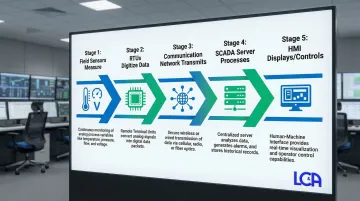
Modern SCADA architecture relies on five interconnected components working together to monitor and control power grid operations.
Remote Terminal Units (RTUs) sit at the edge of the network—in substations, along transmission lines, and at generation sites. These microprocessor-controlled devices interface with sensors measuring voltage, current, frequency, transformer temperature, and breaker status.
Modern RTUs like ABB's XRC G5 run on Linux and convert analog field signals into digital data transmitted to the central SCADA server.
Programmable Logic Controllers (PLCs) provide more sophisticated local automation than RTUs. PLCs execute complex control logic for continuous equipment monitoring, automatic voltage regulation, and fault response sequences without waiting for central commands.
Human-Machine Interface (HMI) software gives operators visual dashboards displaying real-time system status, alarm notifications, and control capabilities. Operators can remotely open or close circuit breakers, adjust transformer taps, and reroute power flows—all from a centralized control room.
Communication infrastructure forms the backbone connecting field devices to the SCADA server. Three protocols dominate:
- DNP3 (IEEE 1815): Designed for low-bandwidth, wide-area telemetry across North American transmission and distribution networks. Supports time-stamped data and secure authentication.
- IEC 61850: Defines communication within substations, enabling real-time peer-to-peer messaging with sub-4-millisecond latency for protection signaling.
- Modbus: Legacy protocol still used for interfacing with older equipment and simple sensors.
SCADA servers process incoming data streams, compare measurements against set limits, generate alarms when parameters exceed thresholds, execute automated control sequences, and store historical data for analysis and compliance reporting.
How SCADA Systems Work in Power Grid Operations
SCADA operates through continuous data acquisition cycles. Sensors measure critical parameters—voltage, current, frequency, power flow, equipment temperature—typically every 4-6 seconds in traditional systems.
RTUs scan connected field devices, digitize measurements, and transmit data packets to the central SCADA server via communication networks.
Operators execute control commands through the HMI—opening circuit breakers during maintenance, adjusting transformer taps to regulate voltage, or rerouting power around faults.
The SCADA server transmits commands to the appropriate RTU or PLC, which performs the physical action and reports status confirmation back to the operator.
The Real-Time Monitoring Cycle
The monitoring cycle never stops. RTUs continuously scan field devices, checking for status changes or measurement deviations.
The SCADA system generates alarms whenever parameters exceed preset thresholds—voltage sags below acceptable levels, current spikes indicating a short circuit, or transformer oil temperature rises dangerously.
Operators receive visual and audible alerts on their HMI screens, displaying the exact location and nature of the problem. They can immediately analyze system status across the entire network, identify affected areas, and initiate corrective actions.
This real-time visibility transforms grid management from reactive firefighting to proactive control.
Automated Control and Decision-Making
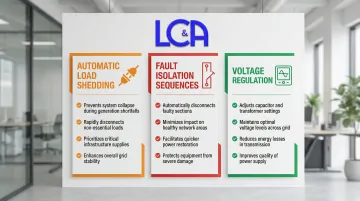
Beyond monitoring, modern SCADA systems act autonomously when milliseconds matter:
- Automatic load shedding disconnects non-critical loads during generation shortfalls or peak demand surges, preventing grid frequency collapse
- Fault isolation sequences automatically open breakers to disconnect problem areas while maintaining service to unaffected customers
- Voltage regulation automation adjusts capacitor banks and transformer taps to maintain power quality without manual intervention
These automated responses happen faster than human operators can react, preventing localized faults from cascading into widespread blackouts.
Similar process control principles apply across industrial facilities. Lashley, Cohen and Associates designs SCADA and process control systems for water/wastewater treatment plants and manufacturing operations, where automated monitoring and control ensure stable, efficient operations across distributed systems.
Key Benefits of SCADA for Power Grid Reliability and Efficiency
Enhanced Grid Reliability
Real-time fault detection reduces outage duration from hours to minutes by pinpointing failure locations. Utilities deploying SCADA-enabled Distribution Automation have reported System Average Interruption Frequency Index (SAIFI) improvements ranging from 17% to 58%.
Specific utility results demonstrate the impact:
- EPB (Chattanooga) achieved a 30% reduction in SAIFI and 20% reduction in SAIDI (2011-2014), saving customers approximately $26.8 million annually
- SMUD (Sacramento) realized 28% savings in SAIDI and 19% savings in SAIFI (2013-2014)
Predictive maintenance capabilities identify equipment degradation before failures occur. By monitoring transformer conditions, insulation resistance, and thermal patterns, SCADA alerts teams to address issues during planned outages.
This shifts maintenance from emergency response to scheduled interventions.
Operational Efficiency Gains
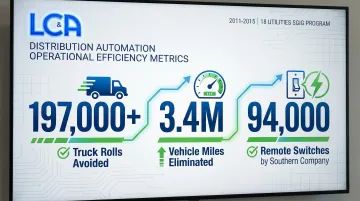
SCADA dramatically reduces operational costs through remote capabilities. Across 18 utilities in the Smart Grid Investment Grant program, Distribution Automation operations avoided over 197,000 truck rolls and 3.4 million vehicle miles traveled between 2011-2015.
Key efficiency metrics include:
- Southern Company: Avoided over 94,000 truck rolls through remote switching
- Vehicle miles: 3.4 million miles eliminated across participating utilities
- Cost savings: Reduced labor, fuel, and response time expenses
Load balancing capabilities distribute power across multiple feeders to prevent overloads and optimize transformer utilization. Real-time SCADA data integration allows utilities to manage power generation more efficiently during non-peak hours, minimizing transmission losses.
Renewable Energy Integration
These efficiency gains become even more critical when managing renewable energy sources. Solar and wind generation fluctuates based on weather conditions, creating stability challenges that require real-time visibility.
Spain's Control Centre of Renewable Energies (CECRE) monitors 98.6% of the country's wind power generation every 12 seconds, with 96% controllable through set-point commands. Operators can adapt production within 15 minutes, maximizing renewable integration while maintaining system security.
SCADA data feeds forecasting models that predict near-term ramp events, enabling operators to balance variable renewable output with conventional generation reserves. Without this real-time coordination, large-scale renewable integration would destabilize grid frequency and voltage.
SCADA vs Other Industrial Control Systems
SCADA vs Distributed Control Systems (DCS)
SCADA and DCS serve fundamentally different operational scopes. SCADA monitors geographically dispersed assets—substations across regions, transmission lines spanning hundreds of miles, distribution networks covering entire service territories. DCS controls processes within a single facility, such as the internal operations of a power plant.
When to use SCADA: Transmission and distribution network monitoring, wide-area protection schemes, renewable energy plant coordination across multiple sites.
When to use DCS: Power plant internal processes—boiler controls, turbine sequencing, emissions management—where continuous, high-speed control loops operate within one location.
Understanding how SCADA compares to related grid management technologies helps clarify where each system adds value.
SCADA vs Energy Management Systems (EMS)
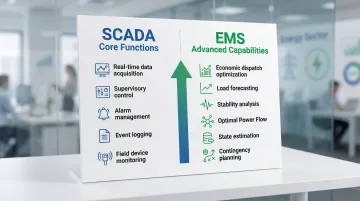
SCADA provides real-time monitoring and control capabilities. EMS adds advanced analytical and optimization functions on top of that foundation.
SCADA core functions:
- Real-time data acquisition from field devices
- Supervisory control of remote equipment
- Alarm management and event logging
EMS advanced capabilities:
- Economic dispatch optimization
- Load forecasting and demand prediction
- Stability analysis and contingency planning
- Optimal Power Flow (OPF) calculations
- State estimation across the network
Modern utilities integrate both systems for comprehensive grid management: SCADA handles data acquisition and supervisory control, EMS uses that real-time data to optimize generation dispatch, predict load patterns, and analyze "what-if" scenarios.
SCADA's Unique Value in Power Applications
SCADA delivers capabilities that other industrial control systems don't match for power grid operations:
- Wide-area visibility: Monitors entire grid infrastructure across regions, not just single facilities
- Dual functionality: Combines real-time monitoring with direct remote control capabilities
- Geographic reach: Manages dispersed assets spanning hundreds of miles
- Integration platform: Serves as foundation for advanced applications like EMS and DERMS
No other technology provides this combination of monitoring and control across geographically dispersed electrical networks.
Real-World SCADA Applications in Power Infrastructure
Substation Automation and Control
SCADA monitors transformer health metrics (oil temperature, insulation resistance, load levels), breaker status (open/closed/tripped), and bus voltages at substations.
Operators can remotely execute switching operations to reroute power during maintenance or emergencies without dispatching field crews.
When Avista Utilities experienced a garbage truck collision with a power pole, their SCADA-enabled Distribution Management System automatically isolated the fault and restored power to over 800 customers instantaneously.
This single automated action saved an estimated 35,600 customer minutes of interruption.
Renewable Energy Plant Management
Solar farms use SCADA as the central control system, monitoring:
- Panel output and inverter performance across thousands of arrays
- Meteorological data (irradiance, temperature, cloud cover)
- String-level diagnostics to identify underperforming sections
- Grid synchronization and power quality compliance
Wind farms use SCADA to track:
- Individual turbine status and generation levels
- Wind speed, direction, and forecasting data
- Grid synchronization and frequency response
- Maintenance scheduling based on operational hours and stress cycles
Beyond utility-scale applications, SCADA extends to industrial facilities where power monitoring intersects with production systems.
Industrial and Manufacturing Facilities
Large industrial complexes face significant power distribution challenges. SCADA monitors electrical distribution within facilities, tracks power quality, and coordinates with process automation systems.
Manufacturing operations with complex electrical infrastructure often integrate SCADA-based power monitoring with process control systems. This connection provides visibility across incoming utility feeds, internal distribution networks, and end-use equipment—enabling facilities to coordinate energy management with production schedules.
Implementation Considerations and Best Practices
Technical and Integration Challenges
Legacy system compatibility presents the biggest hurdle. Many grids operate equipment from multiple vendors spanning decades, using incompatible protocols.
Protocol gateways that translate between legacy standards (Modbus serial, proprietary formats) and modern protocols (DNP3, IEC 61850) enable phased upgrades without replacing every field device simultaneously.
Cybersecurity requirements are now critical as SCADA systems connect to corporate IT networks. NERC CIP standards (CIP-002 through CIP-013) mandate specific protections including:
- Multi-factor authentication for system access
- Network segmentation separating operational technology from IT networks
- Encrypted communications for sensitive data
- Supply chain risk management for vendor products
Scalability planning ensures systems handle future grid expansion, increased renewable penetration, and technology upgrades. Designing architectures with modular components, standardized protocols, and sufficient computing headroom prevents costly overhauls as requirements evolve.
Vendor Selection and Project Planning
Addressing these challenges effectively starts with choosing the right partners. Key selection criteria include:
- Proven track record in power applications with reference installations
- Support for industry-standard protocols (DNP3, IEC 61850, IEC 62351 security)
- Long-term vendor stability and commitment to ongoing support
- Compatibility with existing infrastructure and future technology roadmaps
Experienced automation integrators who understand both SCADA technology and operations deliver better outcomes than software selection alone. These partners bridge the gap between IT capabilities and operational requirements.
For industrial facilities implementing SCADA-based monitoring and control, working with integrators who have deep experience in process control systems and industrial networking ensures implementations meet real-world operational needs.
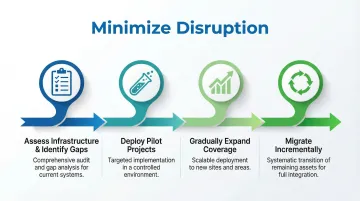
Phased implementation minimizes disruption to existing operations. Rather than "rip and replace," utilities should:
- Assess current infrastructure and identify critical gaps
- Deploy pilot projects in non-critical areas to validate technology
- Gradually expand coverage while maintaining existing systems
- Migrate protocols and platforms incrementally as field devices reach end-of-life
Operator Training and Change Management
Comprehensive operator training on SCADA interfaces and emergency response procedures is non-negotiable. Operators must understand system capabilities, recognize abnormal conditions, and execute correct responses under pressure.
Ongoing skill development keeps pace as SCADA systems evolve. Utilities like Southern California Edison have built robust test labs where personnel train on new technologies before operational deployment.
This approach reduces errors and builds operator confidence in managing advanced control systems.
Frequently Asked Questions
What is the role of SCADA in power grids?
SCADA enables real-time monitoring and remote control of grid equipment across substations, transmission lines, and distribution networks. It detects faults instantly and allows rapid response from centralized control rooms.
What is SCADA in critical infrastructure?
SCADA is the supervisory system used across critical infrastructure sectors—power, water, transportation, oil and gas—to monitor geographically distributed assets and maintain operational continuity.
Why do utilities use SCADA in grid substations?
SCADA provides centralized visibility into substation equipment status and enables remote operation of breakers and switches. This improves response times, lowers operational costs, and reduces the need for on-site personnel.
What are the main components of a SCADA system?
Core components include Remote Terminal Units (RTUs) for field data collection, PLCs for local automation, communication networks using DNP3 and IEC 61850 protocols, and SCADA servers with HMI software for visualization and control.
How does SCADA improve power grid reliability?
SCADA combines real-time fault detection, automated response, and predictive maintenance to minimize outages. Automated fault isolation reduces interrupted customers by up to 55% and restores power in under one minute versus five-plus minutes manually.
What is the difference between SCADA and DCS?
SCADA monitors geographically dispersed systems across wide areas like transmission and distribution networks, while DCS controls processes within a single facility. SCADA is standard for power grids; DCS is used for localized industrial process control.