Introduction
With $14.6 billion in new capital investment announced for 2025 and manufacturing output exceeding $48 billion annually, Alabama's industrial base is expanding fast. For operations managers at water treatment plants, chemical manufacturers, steel mills, and food processing facilities, the pressure to modernize control systems is real — outdated monitoring creates blind spots that cost time, money, and safety.
A capable SCADA system integrator doesn't just install software — they architect the control infrastructure your facility depends on. That means detecting problems before they cascade, giving operators real-time visibility, and hitting uptime targets consistently.
The wrong choice leads to scope creep, budget overruns, and systems that underperform from day one.
This guide profiles the top 5 SCADA system integrators serving Alabama, evaluated on industry certifications, technical depth, sector experience, and documented project outcomes. Whether you're upgrading a legacy system or designing greenfield infrastructure, these firms represent the strongest options for Alabama-based facilities.
TL;DR
- SCADA integrators design supervisory control systems that give industrial facilities centralized, real-time visibility over operations
- Alabama's key sectors—water/wastewater, chemicals, steel, food & beverage—rely heavily on SCADA for process optimization and regulatory compliance
- Top integrators are evaluated on credentials (ISO, PE licensure, vendor partnerships), industry experience, and client track record
- Lashley, Cohen and Associates stands out for ISO-9001 quality processes, Rockwell partnership, a certified PE Engineer, and 35+ years of multi-sector experience
- Match your integrator to your industry and project scale—not just name recognition
Overview of SCADA System Integration in Alabama
SCADA (Supervisory Control and Data Acquisition) integration involves connecting field devices, PLCs, RTUs, and HMIs into a unified control and monitoring system. According to NIST SP 800-82, SCADA systems provide centralized data acquisition and supervisory control over dispersed assets—making them foundational to modern industrial operations where real-time visibility directly impacts safety, efficiency, and compliance.
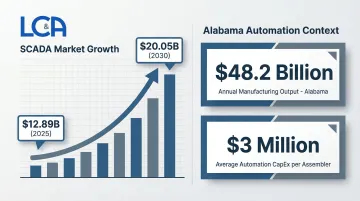
Alabama's industrial landscape is both diverse and automation-intensive. The state's 290,000 manufacturing workers generate $48.2 billion in annual output across sectors including steel, chemicals, pulp and paper, automotive, and power generation.
That scale comes with significant infrastructure complexity. With 23 hydroelectric dams on the grid and major capital projects like Georgia-Pacific's $800 million Alabama River Cellulose mill modernization, the demand for reliable SCADA infrastructure continues to grow.
Southern assemblers averaged nearly $3 million in automation capital expenditures in 2023, driven by reshoring initiatives, federal incentives, and labor shortages. The global SCADA market is projected to grow from $12.89 billion in 2025 to $20.05 billion by 2030, reflecting the critical role these systems play in the shift to connected, automated industrial operations.
For Alabama facilities navigating this investment, the right integrator makes a measurable difference — in project timelines, system reliability, and long-term support. The five companies below were selected based on technical capability, regional presence, and demonstrated experience in Alabama's core industrial sectors.
Top 5 SCADA System Integrators in Alabama
These integrators were evaluated on industry certifications, range of SCADA capabilities, sector experience, and demonstrated client outcomes.
Lashley, Cohen and Associates
Founded in 1988, Lashley, Cohen and Associates delivers end-to-end controls integration, SCADA implementation, and engineering services across the Southeast. With over 35 years serving industrial clients, the firm has completed 5,000+ projects for 2,000+ clients across food & beverage, water/wastewater, chemicals, metals, and manufacturing sectors.
Their credentials include an ISO-9001 certified project management process, a Certified PE Engineer on staff, and Rockwell Systems Bronze Partner status — a combination of quality management, engineering accountability, and vendor-validated platform expertise that few regional integrators can match.
That depth shows in their project outcomes. They've optimized a beverage filling line from 1,100 to 1,600 containers per minute — a 50% throughput gain — and deployed complete control systems for water treatment facilities.
| Category | Details |
|---|---|
| Location / Service Area | Lawrenceville, GA (headquarters); serves Alabama and broader Southeast |
| Key Certifications & Credentials | ISO-9001 certified, Rockwell Systems Bronze Partner, Certified PE Engineer on staff |
| Industries Served | Food & Beverage, Water/Wastewater, Chemicals, Metals, Manufacturing, Building Materials, Consumer Goods |
RL Consulting Inc.
Based in Muscle Shoals, Alabama, RL Consulting Inc. is an electrical control systems integrator founded in 2003. With over two decades of experience, the firm provides control system solutions across the United States, with deep roots in Alabama's heavy industry corridor.
RL Consulting differentiates through expertise in complex, high-stakes environments like pulp and paper, steel, textiles, and automotive manufacturing — sectors where a control system failure carries immediate production and safety consequences. The firm holds ISO 9001:2015 certification and is a Rockwell Automation partner, indicating validated competency with Allen-Bradley platforms. Their in-state location provides responsive service for Alabama's manufacturing base.
| Category | Details |
|---|---|
| Location / Service Area | Muscle Shoals, Alabama; national reach |
| Key Certifications & Credentials | ISO 9001:2015 certified, Rockwell Automation Partner |
| Industries Served | Pulp & Paper, Steel, Textiles, Automotive, General Manufacturing |
Process Automation and Controls Inc. (PAC)
Founded in 1999 and based in Foley, Alabama, PAC is a professional engineering firm specializing in process control system engineering, instrumentation, and field services. The firm has served clients across the U.S., Canada, and Mexico for over 25 years.
PAC stands out for its dual capability as both a licensed professional engineering firm and a VTScada Certified Solution Provider. Their ISO/IEC 17025:2017 accreditation for testing and calibration laboratories demonstrates the technical rigor required for power generation, pulp and paper, and chemical processing applications where instrument accuracy and control reliability directly impact safety and profitability.
| Category | Details |
|---|---|
| Location / Service Area | Foley, Alabama; serves U.S., Canada, and Mexico |
| Key Certifications & Credentials | Alabama Professional Engineering license, VTScada Certified Solution Provider, ISO/IEC 17025:2017 accredited |
| Industries Served | Power Generation, Pulp & Paper, Chemical Processing |
JMJ Automation
Located in Troy, Alabama, JMJ Automation is a SCADA-focused integrator and VTScada Certified Solution Provider with core specialization in water and wastewater applications — a critical sector for municipalities and utilities across Alabama.
JMJ Automation differentiates through an affordable, scalable approach to SCADA integration. They developed the VTScadaLIGHT demo platform specifically to help smaller utilities understand hardware integration options and system capabilities before committing to full deployment. This focus on expandable systems that grow with the client makes them ideal for municipal water systems and regional utilities managing distributed infrastructure.
| Category | Details |
|---|---|
| Location / Service Area | Troy, Alabama; regional focus across Alabama |
| Key Certifications & Credentials | VTScada Certified Solution Provider |
| Industries Served | Water & Wastewater (primary focus), Industrial Applications |
Deep South Automation
Based in Newton, Alabama, Deep South Automation is a regional SCADA integrator and VTScada Certified Solution Provider offering localized integration expertise to industries and utilities across the Deep South.
Their VTScada certification validates technical competency with a platform widely used in water/wastewater and industrial monitoring. For Alabama facilities that prioritize proximity and hands-on site support, Deep South offers a locally grounded option — particularly suited to projects where ongoing, in-person collaboration matters.
| Category | Details |
|---|---|
| Location / Service Area | Newton, Alabama; Deep South regional service area |
| Key Certifications & Credentials | VTScada Certified Solution Provider |
| Industries Served | Water/Wastewater, Industrial Applications |
How We Chose the Best SCADA System Integrators in Alabama
Each firm was evaluated on verifiable factors: industry certifications (ISO, PE licensure, vendor partnerships), breadth of SCADA platform expertise, sector coverage, geographic service reach, and documented project experience.
Key selection criteria:
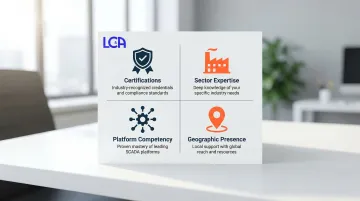
- Certifications: CSIA certification and ISO 9001 are key differentiators, with certified integrators demonstrating better business management and lower project risk. Major vendors like Rockwell Automation use CSIA certification as a benchmark for top-tier partners.
- Sector expertise: Experience in your specific industry — water/wastewater, chemicals, food processing — matters more than generic automation credentials.
- Platform competency: Vendor partnerships (Rockwell, VTScada) indicate validated technical expertise and access to direct support channels.
- Geographic presence: Local or regional integrators provide faster response times and better understanding of state-specific regulatory requirements.
The common mistake buyers make: choosing a vendor purely on price or name recognition without verifying technical credentials. A low bid from an uncertified integrator often leads to scope creep, missed deadlines, and systems that fail to meet performance requirements.
The right integrator for your facility is the one whose experience matches your specific industry, control system complexity, and scalability needs — not necessarily the largest or lowest-priced firm. That fit determines real-world outcomes: uptime, regulatory compliance, data integrity, and what you actually pay over the system's lifetime.
Conclusion
Alabama's industrial sectors depend on robust, well-integrated SCADA systems. The integrator you choose directly shapes your facility's ability to monitor, respond, and optimize in real time. With 95% of U.S. industrial firms planning new automation within three years, your SCADA infrastructure will determine whether you lead that transition or get left behind it.
Choosing the right partner means going beyond brand familiarity. Evaluate each candidate on:
- Certified engineers with documented experience in your specific sector
- Scalable system architectures that grow with your operations
- ISO-9001 certification, PE licensure, and active vendor partnerships
- A structured project management process with a verifiable track record
For facilities across Alabama and the Southeast, Lashley, Cohen and Associates brings ISO-9001 certified processes, a certified PE engineer on staff, and 35+ years of cross-industry project experience. Contact us at websales@lashleycohen.com or (770) 962-0878 to discuss your project requirements.
Frequently Asked Questions
What does a SCADA system integrator do?
A SCADA integrator designs, configures, and deploys the hardware and software components—including PLCs, HMIs, communication networks, and SCADA software—that allow operators to monitor and control industrial processes from a centralized interface. They handle everything from field device wiring to database configuration and cybersecurity hardening.
What industries in Alabama commonly use SCADA systems?
Key Alabama industries include water/wastewater utilities, chemical plants, steel manufacturing, pulp and paper, food and beverage processing, and power generation — all relying on SCADA for process visibility, regulatory compliance, and operational control. Alabama's 23 hydroelectric dams and large manufacturing base drive consistent demand for reliable SCADA infrastructure.
How do I choose the right SCADA integrator for my facility?
Prioritize integrators with relevant industry certifications (ISO, PE licensure), experience in your specific sector, proven platform partnerships (Rockwell, Siemens, VTScada), and a structured project management process. Don't default to the lowest bid—uncertified integrators often deliver systems that underperform or require expensive rework.
What certifications should a SCADA system integrator have?
Look for ISO-9001 certification for quality management, PE (Professional Engineer) licensure for engineered systems, and vendor-specific partnerships (Rockwell, VTScada) that indicate validated platform expertise. CSIA certification signals strong business management and consistent project delivery.
How long does a SCADA integration project typically take?
Timelines vary widely based on system complexity and site conditions. Simple systems with fewer than 50 I/O points may take 3-6 weeks, while full-facility integrations with thousands of devices can span several months. Complex multi-site implementations may require 12-18 months. A qualified integrator should provide a detailed project schedule during scoping.
What is the difference between a SCADA integrator and a SCADA software vendor?
A software vendor develops and sells the SCADA platform (Ignition, VTScada, FactoryTalk), while a systems integrator configures, customizes, and deploys that platform within a specific facility's control architecture. Integrators typically hold certified vendor partnerships, giving them access to deeper technical support and platform-specific training.