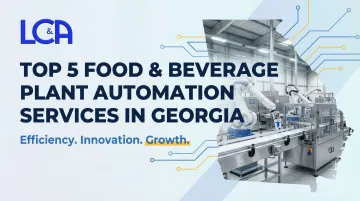
Food and beverage plant automation services encompass controls integration, PLC programming, SCADA/HMI systems, sanitary panel design, and commissioning support. Choosing a local, experienced provider matters because downtime costs thousands per hour, and food safety compliance violations carry severe financial and reputational penalties. The right partner understands washdown requirements, FSMA traceability mandates, and the unique challenges of high-SKU production environments.
TL;DR
- Georgia's food and beverage sector spans 1,500+ facilities and $100 billion in output, with 44% of processors raising automation budgets
- Top integrators cover PLC/SCADA systems, controls integration, packaging line optimization, and food-safe engineering
- Key selection criteria: CSIA certification, PE engineers on staff, and verified F&B project history
- Top providers include Lashley Cohen, Stellar, Gray Solutions, Hargrove, and Factory Automation Systems based on credentials and client outcomes
- Prioritize FSMA readiness, hygienic design expertise, and long-term support over upfront cost alone
Overview of Plant Automation in Georgia's Food and Beverage Industry
Food and beverage plant automation services encompass the design, integration, and support of control systems that manage mixing and batching, conveyor networks, packaging lines, SCADA/HMI interfaces, and food-safety-compliant electrical infrastructure. These systems must meet stringent hygienic standards while delivering the throughput and traceability that modern food manufacturing demands.
Georgia's food manufacturing sector employs approximately 370,400 workers and accounts for 29% of all food processing jobs in the Southeast. The state also hosts operations for nearly half of the nation's top 100 food companies — making it one of the most active markets for specialized automation services in the country.
Several factors are pushing facilities to invest now:
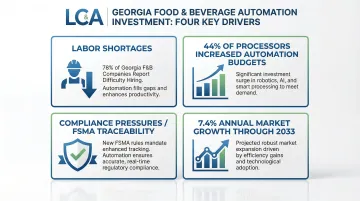
- Labor shortages are forcing plants to automate roles that were previously filled manually
- 44% of food processors have increased automation budgets over the past two years
- Compliance pressures around food safety traceability are raising the bar for control system requirements
- Global food automation market is projected to grow at 7.4% annually through 2033
The five providers below were selected based on industry-specific experience, technical capability, and demonstrated results in Georgia's food and beverage sector.
Top 5 Food and Beverage Plant Automation Services in Georgia
Providers were evaluated on food and beverage project history, certifications (ISO-9001, CSIA, PE credentials), technology partnerships, service breadth, and verifiable client outcomes in compliance-driven manufacturing environments.
Lashley, Cohen and Associates
Founded in 1988 and headquartered in Lawrenceville, GA, Lashley, Cohen and Associates is a controls integration and engineering firm with over 35 years of experience serving food and beverage manufacturers including Sugar Foods and Bensons Bakery.
Key differentiators:
- ISO-9001 certified project management process ensuring consistent quality and reduced rework
- Certified PE Engineer on staff for code-compliant electrical designs
- Rockwell Systems Bronze Partner with proven expertise in Allen-Bradley platforms
- 5,000+ completed projects across food, beverage, and general manufacturing
- Proactive approach aligning automation solutions with clients' long-term production goals
Notable F&B achievements: Optimized a beverage filling line from 1,100 to 1,600 containers per minute (50% throughput increase) and implemented gas-fired oven controls upgrades that reduced process variability while improving quality. Provides ongoing support for food container manufacturing facilities with servo-controlled throughput systems and 100% vision inspection.
| Certifications & Credentials | ISO-9001 certified; Rockwell Systems Bronze Partner; Certified PE Engineer on staff |
|---|---|
| Core Services | Controls integration, PLC/SCADA programming, panel design, project management |
| F&B Clients Served | Sugar Foods, Bensons Bakery; 2,000+ total clients across food, beverage, and general manufacturing |
Stellar Group Inc.
Stellar Group is a Jacksonville, FL-based design-build firm with significant Georgia presence, including a major 2023 renovation for Crown Bakeries in Smyrna, GA. The company specializes in full-facility engineering, process systems, and automation controls for food and beverage operations.
Key differentiators:
- Rockwell Automation Authorized Integrator with expertise in 3-A sanitary standards
- CSIA-audited project management processes
- Full design-build capability integrating architecture, process engineering, refrigeration, and controls
- Proven track record in dairy, bakery, and beverage facility construction and automation
Stellar's integrated approach combines facility design with control systems, aligning automation infrastructure with process flow and hygienic requirements from the start. The Crown Bakeries renovation was completed inside an active production facility — a technically demanding constraint that required tight coordination between construction, process, and controls teams.
| Certifications & Credentials | Rockwell Automation Authorized Integrator; CSIA Member; 3-A Standards expertise |
|---|---|
| Core Services | Design-build construction, process engineering, controls integration, refrigeration, SCADA |
| Notable F&B Work | Crown Bakeries (Smyrna, GA), Fairlife (Goodyear, AZ), Bell & Evans (PA) |
Gray Solutions
Headquartered in Lexington, KY, Gray Solutions opened an Atlanta office in September 2024 to support Southeast expansion. The company completed a major greenfield facility for Yakult in Cartersville, GA, establishing a concrete foothold in the Georgia market.
Key differentiators:
- CSIA Certified with audited quality management systems
- Rockwell Automation Platinum System Integrator (highest tier partnership)
- Digital transformation and Industry 4.0 expertise including robotics and vision systems
- Full EPC (Engineering, Procurement, Construction) capability for turnkey delivery
Gray's Platinum tier with Rockwell — the highest available — reflects sustained volume and technical depth across large-scale projects. The Yakult facility in Cartersville was built from the ground up, covering process design, automation, and commissioning across a multi-discipline food manufacturing environment.
| Certifications & Credentials | CSIA Certified; Rockwell Automation Platinum System Integrator |
|---|---|
| Core Services | Digital transformation, robotics, vision systems, EPC delivery, MES/ERP integration |
| Notable F&B Work | Yakult (Cartersville, GA), pet food manufacturer supply chain solution |
Hargrove Controls & Automation
Based in Mobile, AL, Hargrove maintains offices in both Atlanta and Savannah, GA, providing strong coverage across the state. The company specializes in FDA food-grade batch processes, continuous controls, and cGMP-compliant systems.
Key differentiators:
- CSIA Certified; named System Integrator of the Year (2022)
- UL-Certified Panel Fabricator ensuring electrical safety compliance
- FDA food-grade and cGMP process expertise for regulated environments
- DCS/PLC/SIS system integration and migration capabilities
Dual Georgia office locations mean faster field response when production goes down. UL panel certification and FDA process specialization are particularly relevant for food manufacturers running validated systems or hygienic electrical designs — environments where an uncertified vendor creates compliance risk.
| Certifications & Credentials | CSIA Certified; UL-Certified Panel Fabricator; System Integrator of the Year (2022) |
|---|---|
| Core Services | Panel fabrication, DCS/PLC/SIS integration, system migration, Industry 4.0, FDA batch controls |
| Notable F&B Work | FDA food-grade batch processes, continuous control systems, cGMP-compliant automation |
Factory Automation Systems
Atlanta-based Factory Automation Systems serves the Georgia market with turnkey automation solutions spanning programmable controllers, manufacturing information systems, motion control, and robotics.
Key differentiators:
- CSIA Certified with audited project management standards
- Rockwell Automation Partner with platform expertise
- Local Atlanta presence enabling rapid on-site support
- Explicit food and beverage industry vertical focus
For Georgia food plants, Factory Automation's Atlanta base means on-site response without the travel time that out-of-state firms add to every service call. CSIA certification confirms their project management processes meet independently audited standards — a meaningful baseline for any F&B engagement.
| Certifications & Credentials | CSIA Certified; Rockwell Automation Partner |
|---|---|
| Core Services | Turnkey automation, PLC systems, manufacturing information systems, motion control, robotics |
| Notable F&B Work | Food & Beverage listed as core industry vertical with project portfolio |
How We Chose the Best Food and Beverage Plant Automation Services in Georgia
Many plant managers select automation providers based solely on price or existing vendor relationships, without validating food-industry-specific expertise, local service capacity, or project management rigor. This approach often leads to cost overruns, compliance gaps, and extended commissioning timelines.
We evaluated providers on five critical factors:
- Industry certifications: ISO-9001, CSIA membership, PE engineers, and UL panel shop credentials demonstrate audited quality processes and technical ability
- Technology partnerships: Rockwell and Siemens partner tiers (Bronze through Platinum) indicate vendor-validated expertise and access to advanced training
- Proven F&B experience with food-safety compliance, hygienic design, and high-SKU production environments
- Georgia service capability: Local presence or established offices reduce response time during unplanned outages
- Service breadth: Full-spectrum capability from design through commissioning and ongoing support
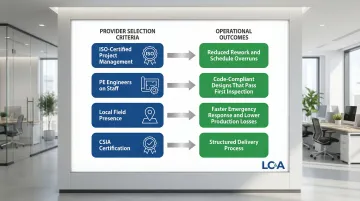
Each factor connects directly to operational outcomes:
- ISO-certified project management reduces rework and schedule overruns
- PE engineers produce code-compliant designs that clear inspections the first time
- Local presence cuts production losses when emergency service calls can't wait
- CSIA-certified integrators follow a structured delivery process that non-certified competitors typically skip
Conclusion
The right automation partner for a Georgia food and beverage plant brings more than technical capability—they understand the regulatory pressures of FSMA traceability, the physical demands of washdown environments, and the throughput requirements of high-SKU production.
When evaluating providers, look beyond upfront project cost. The gap between a $200,000 and $250,000 integration becomes irrelevant if the lower-cost provider can't respond when your line goes down. Assess each candidate on:
- Ongoing support response time and field availability
- Scalability to handle future SKU or throughput changes
- Food-safety expertise, including FSMA and washdown-rated system design
- Alignment with your long-term operational goals, not just the current project scope
If you're considering controls integration or plant automation upgrades, contact Lashley, Cohen and Associates at (770) 962-0878 or websales@lashleycohen.com to discuss your specific production challenges and explore how 35+ years of controls engineering experience—backed by ISO-9001 certification and food & beverage project history—can improve throughput, reduce waste, and keep your facility compliant.
Frequently Asked Questions
What services do food and beverage plant automation companies in Georgia typically offer?
Services include PLC/SCADA programming, HMI design, controls panel fabrication with hygienic ratings, conveyor and packaging line integration, batch control systems, machine vision inspection, and ongoing field service support. Providers typically include commissioning, FDA validation documentation, and legacy system migration as part of full-scope engagements.
How much does food and beverage plant automation typically cost?
Costs vary widely by scope: a single control panel upgrade runs $45,000–$90,000, automated case packers range from $200,000–$400,000, and vision systems fall between $25,000–$250,000 depending on complexity. Full integration typically costs 2–6x the hardware price once engineering, programming, and commissioning labor are included. Sanitary-rated equipment adds a 20–40% premium over standard industrial components.
What certifications should I look for in a food and beverage automation service provider?
Prioritize ISO-9001 for project management quality, CSIA certification for systems integrators (which correlates with 5-8% higher success rates), PE engineer credentials for electrical compliance, and UL panel shop certification. Verified technology partnership status with major vendors like Rockwell or Siemens also signals access to advanced technical resources and manufacturer-level support.
How long does it take to implement an automation system in a food or beverage plant?
Timelines depend on complexity: a single control panel upgrade takes 2–4 weeks, packaging line integration requires 3–6 months including equipment procurement, and full greenfield facilities need 9–12+ months. Phased implementations with parallel testing and weekend cutovers are common strategies for minimizing production disruption.
What are the most common automation challenges specific to food and beverage plants?
Challenges include washdown-rated electrical requirements (IP69K/NEMA 4X) for sanitary environments, FDA FSMA traceability compliance requiring automated data capture of Key Data Elements, frequent product changeovers for high-SKU operations, and real-time visibility needs across batch or continuous processes. Equipment must withstand high-pressure steam cleaning while maintaining food-contact surface standards.
How do I know if my food plant is ready for automation?
Key readiness indicators include recurring labor bottlenecks, inconsistent product quality, traceability audit findings, and plans to scale beyond current capacity. If manual data entry errors or difficulty filling production roles are ongoing issues, a facility assessment from a qualified integrator will identify the highest-ROI starting points.