Introduction
When a PLC fails in a South Carolina manufacturing facility, production stops — immediately and completely. In the automotive sector, unplanned downtime costs up to $2.3 million per hour. General manufacturing facilities aren't far behind, with losses ranging from $10,000 to $500,000 per hour.
Those stakes are high in South Carolina. The state's manufacturing sector employs approximately 263,600 workers, generated a 36% GDP increase from 2020 to 2024, and ranks as the #1 U.S. exporter of passenger vehicles and tires. Fast, qualified PLC repair isn't just about getting back online — it's about protecting significant capital investments and avoiding expensive system replacements.
This article evaluates the top 5 PLC troubleshooting and repair services operating in or serving South Carolina, based on engineering credentials, brand compatibility, response time, and proven track record.
TL;DR
- PLCs fail at critical moments—production stops until they're repaired
- South Carolina's 263,600+ manufacturing workers rely on fast, multi-brand PLC repair services
- Top providers are ranked on ISO certification, multi-brand expertise, and emergency response speed
- Lashley, Cohen and Associates leads with 35+ years of experience, ISO-9001 certification, and Rockwell Bronze Partner status
- 70–80% of failed PLCs are repairable; the right service provider can save hundreds of thousands in replacement costs
Overview of PLC Troubleshooting and Repair in South Carolina
PLC troubleshooting and repair involves diagnosing and resolving faults in programmable logic controllers—from I/O failures and communication errors to firmware corruption and hardware damage—to restore normal machine or line operation.
South Carolina's Industrial Landscape
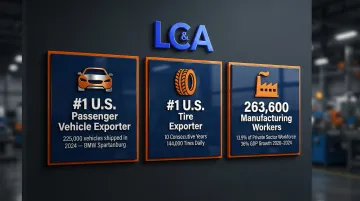
South Carolina's manufacturing sector employs 263,600 workers as of Q4 2024, representing 13.9% of the state's private sector workforce. Manufacturing GDP surged 36% from 2020 to 2024, driven by automation investments rather than headcount expansion. The state's top industries—automotive, tires, chemicals, and food processing—depend heavily on PLC-driven automation.
South Carolina's industrial profile includes some standout figures:
- #1 U.S. passenger vehicle exporter — BMW's Spartanburg plant shipped 225,000 vehicles in 2024
- #1 U.S. tire exporter for 10 consecutive years, producing 144,000 tires daily
- Major chemical, food processing, and building materials facilities running continuous-process lines
In these industries, unplanned PLC downtime isn't just an inconvenience — it directly cuts into production output and revenue. That's what makes the service providers below worth knowing.
Top 5 PLC Troubleshooting and Repair Services in South Carolina
These providers were selected based on engineering credentials, PLC brand compatibility, industry experience, responsiveness, and client trust—not just market visibility. Each entry below covers what sets them apart, which platforms they support, and who they serve best.
1. Lashley, Cohen and Associates
Founded in 1988 and ISO-9001 certified, Lashley, Cohen and Associates is a controls integration and industrial automation firm with over 35 years of experience serving manufacturers across the Southeast, including South Carolina. As a Rockwell Systems Bronze Partner, they specialize in Allen-Bradley PLC diagnostics, repair, and reprogramming, alongside broader controls integration and engineering services.
Why They Stand Out:
- ISO-9001 certified processes ensure repeatable, documented repair quality across all engagements
- Certified PE Engineer on staff — engineering rigor rarely found at PLC repair shops
- 5,000+ completed projects across food & beverage, chemicals, metals, and water/wastewater
- Rockwell Bronze Partner status means factory-backed competency for Allen-Bradley systems
- Field service model with on-site troubleshooting throughout South Carolina
- Multi-platform expertise beyond Allen-Bradley, confirmed by client testimonials
| Certifications & Credentials | ISO-9001 certified, Rockwell Systems Bronze Partner, Certified PE Engineer on staff |
|---|---|
| PLC Brands / Platforms Supported | Allen-Bradley / Rockwell Automation (ControlLogix, CompactLogix, SLC 500, PLC-5), multiple other manufacturers' platforms |
| Industries Served | Food & Beverage, Chemicals, Metals, Water/Wastewater, Consumer Goods, Building Materials, General Manufacturing |
Contact: (770) 962-0878 | websales@lashleycohen.com
2. Palmetto Automation
Founded in 2015 and based in Duncan, SC (Greenville/Spartanburg area), Palmetto Automation provides in-house depot repair and surplus sales with a strong focus on the Upstate region. Their ISO 9001 certification and local presence suit manufacturers who need rapid turnaround on common PLC failures without shipping equipment out of state.
Key Strengths:
- Physical location in Duncan, SC enables same-day drop-off and pickup for local facilities
- Board-level repair expertise for obsolete and hard-to-find components
- 12-month warranty on all repairs
- Multi-brand capability across six major PLC manufacturers
| Certifications & Credentials | ISO 9001 Certified |
|---|---|
| PLC Brands / Platforms Supported | Allen-Bradley, Siemens, Mitsubishi, Omron, Schneider Electric, GE Fanuc |
| Industries Served | General Manufacturing, Automotive Suppliers, Textiles, Food Processing |
3. Global Electronic Services (GES)
Established in 2000 and based in Buford, GA, Global Electronic Services operates an East Coast hub that explicitly serves South Carolina with free pickup and delivery. Their ISO 9001:2015 certification and fast turnaround times, including 1-2 day rush options, make them a practical choice for high-volume repair needs.
Notable Capabilities:
- 1-2 day rush service available for emergency situations
- 2-year in-service warranty — the longest in this comparison
- Free pickup and delivery for South Carolina customers eliminates logistics costs
- Repair Price Guarantee promises to beat competitor quotes
- 24/7 support line for critical downtime situations
| Certifications & Credentials | ISO 9001:2015 |
|---|---|
| PLC Brands / Platforms Supported | Allen-Bradley, Siemens, Schneider, Modicon, GE, Fanuc, and thousands of others |
| Industries Served | Automotive, Food & Beverage, Chemicals, Metals, Pharmaceuticals, General Manufacturing |
4. ACS Industrial Services
Founded in 1999 and based in Hickory, NC, ACS Industrial Services operates as a regional depot repair hub with a strong focus on cost savings. Their WBENC certification and U.S. Government approval add credibility for facilities requiring vendor compliance.
Why They Stand Out:
- Free evaluations with no obligation — transparency before committing to repair
- 2-year warranty matches the best in this comparison
- Up to 80% savings compared to new equipment replacement costs
- Rush service (3-5 days) available for urgent needs
- WBENC certified (Women's Business Enterprise) for diversity procurement requirements
| Certifications & Credentials | WBENC (Women's Business Enterprise), U.S. Government Approved Vendor |
|---|---|
| PLC Brands / Platforms Supported | Allen-Bradley (SLC 500, PLC-5, ControlLogix), Siemens, GE, Modicon, Omron |
| Industries Served | Automotive, Aerospace, Food & Beverage, Water Treatment, General Manufacturing |
5. Cimtec Automation
With offices in North Carolina, South Carolina, and Georgia, Cimtec Automation specializes in repairs, support, and migrations for facilities dealing with legacy system obsolescence. Their partnership with Qualitrol International provides access to certified repair processes for multiple PLC brands.
Why They Stand Out:
- Regional office presence in South Carolina enables faster response than distant depots
- Legacy system expertise for GE and obsolete Rockwell platforms requiring migration
- 1-year limited warranty on Level 2 repairs
- Migration planning services help facilities transition from discontinued platforms to modern systems
- Qualitrol partnership provides access to OEM-level repair standards
| Certifications & Credentials | ISO 9001 (via Qualitrol partnership) |
|---|---|
| PLC Brands / Platforms Supported | Allen-Bradley, Siemens, Schneider Electric, GE (Legacy), Modicon |
| Industries Served | Automotive, Chemicals, Textiles, Pulp & Paper, General Manufacturing |
How We Chose the Best PLC Troubleshooting and Repair Services
Selecting a PLC service provider based on price alone is a common mistake that can lead to recurring failures or unvalidated repairs. The right provider should demonstrate engineering credentials, brand-specific expertise, and quality management processes that ensure long-term reliability.
Core Selection Criteria
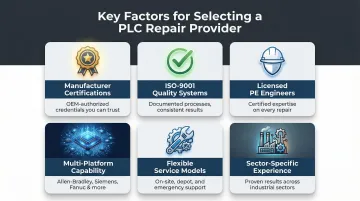
- Manufacturer certifications (Rockwell Bronze Partner, Siemens Authorized): validate technical competency and reduce first-time fix times through access to proprietary diagnostic tools
- ISO-9001 quality systems: ensure documented, repeatable repair processes — not ad-hoc troubleshooting — with proper testing and validated outcomes
- Licensed PE engineers on staff: signal engineering rigor beyond technician-level work, which matters for root cause analysis and regulatory compliance
- Multi-platform capability: providers who service Allen-Bradley, Siemens, Mitsubishi, and legacy systems prevent unnecessary replacements driven by single-brand gaps
- Flexible service models: depot repair for cost efficiency, on-site service for complex faults — the best providers offer both based on the situation
- Sector-specific experience: documented work in your industry (food & beverage, chemicals, metals) means the provider understands your operational constraints and regulatory requirements
Questions to Ask Before Hiring
Before committing to a PLC repair vendor, ask for specifics that reveal how they actually operate:
- Documented repair processes and testing protocols
- Warranty terms on repaired units
- Client references from your specific industry
- Turnaround times for standard and emergency service
- Parts sourcing capabilities for legacy systems
These details quickly separate full-service engineering partners from basic repair shops.
Conclusion
The right PLC troubleshooting and repair partner does more than fix a broken unit—they help industrial facilities build long-term operational resilience, reduce unplanned downtime, and plan for control system modernization. With 70-80% of failed PLCs being repairable at the component level, choosing a qualified service provider can save hundreds of thousands in replacement costs while maintaining production continuity.
South Carolina manufacturers should evaluate providers on more than current capabilities. As legacy PLC systems age and migration to newer platforms accelerates, the right partner needs to address your operation at every stage. Key criteria to assess:
- Scalability — Can they support your facility as automation complexity grows?
- Responsiveness — Do they offer emergency support and fast turnaround when downtime is active?
- Integration depth — Can they handle both repair and migration to modern control platforms?
- Long-term alignment — Do they understand your production roadmap, not just your broken hardware?
If those criteria matter to your operation, Lashley, Cohen and Associates checks each one. With ISO-9001 certified processes, Rockwell Systems Bronze Partner status, and over 35 years supporting industrial facilities, they bring both repair expertise and integration capability under one roof. Reach out at (770) 962-0878 or websales@lashleycohen.com to discuss your PLC service needs.
Frequently Asked Questions
What is PLC troubleshooting and how is it different from PLC repair?
Troubleshooting is the diagnostic process of identifying the root cause of a PLC malfunction—such as a failed I/O module, corrupted program, or power fault. Repair involves physically fixing or replacing the faulty component and restoring the system to operational status. Troubleshooting always precedes repair.
What are the most common causes of PLC failure?
The most frequent failure modes include:
- Power supply issues and wiring defects
- I/O module failures and communication port faults
- Environmental damage from heat, moisture, or vibration
- Firmware or memory corruption and aging legacy hardware
Over 70% of failures trace back to power instability, wiring defects, or I/O module issues.
How long does PLC repair typically take?
Repair timelines depend on fault complexity and PLC model. Bench repairs for common units typically take 1–5 business days, while rush options deliver 1–2 day turnaround. On-site work for complex or custom-programmed systems may require additional time.
Can a damaged PLC always be repaired, or does it sometimes need to be replaced?
Many PLC faults—especially component-level failures—are repairable, with industry data showing 70–80% repair success rates. However, severely damaged units, obsolete models with no available parts, or systems with unrecoverable logic may require replacement. Units under 5 years old are almost always repairable.
What certifications should I look for in a PLC repair service provider?
Look for manufacturer partnerships (Rockwell Authorized Service Provider or Bronze Partner, Siemens Solution Partner), ISO-9001 certification, and licensed Professional Engineers on staff. These credentials confirm brand-specific technical competency and validated quality processes.
How much does PLC troubleshooting and repair typically cost?
Flat-rate repairs for Rockwell modules typically run $1,180–$1,500, while third-party repairs range from $100 to $2,200 depending on module type. Many shops offer free evaluations with a minimum bench fee around $340 if repair proceeds. Emergency or on-site service generally carries a 50–100% premium over standard depot pricing.